What Sets These Two Floors Apart at a Structural Level
Both products have real wood on top - but what lies beneath makes all the difference in how they perform over time.
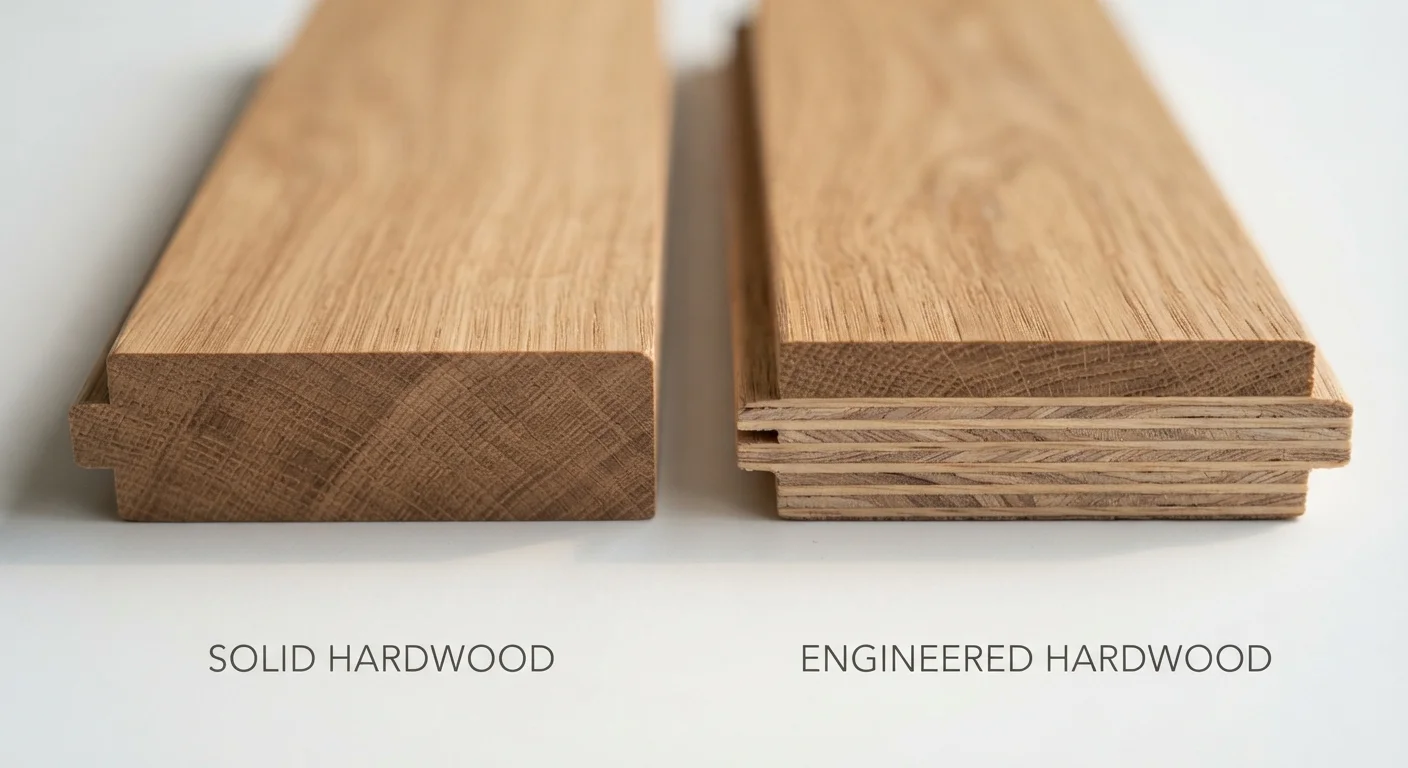
Solid hardwood is exactly what it sounds like: a single piece of milled lumber, typically ¾ inch thick, cut from species like oak, maple, or hickory. Because wood is a natural material, it expands and contracts with changes in humidity and temperature. That movement is manageable in controlled, dry spaces - but it creates problems in areas prone to moisture.
Engineered hardwood, by contrast, is built in layers. A thin veneer of real hardwood - usually between 1-6 mm thick - sits on top of a core made from plywood or high-density fiberboard (HDF). Those core layers are arranged in opposing grain directions, which counteracts the natural tendency to expand or shrink. The result is a floor that looks and feels like solid wood on top but behaves far more predictably under changing conditions.
| Criterion | Solid Hardwood | Engineered Hardwood |
|---|---|---|
| Construction | Single piece of milled lumber | Wood veneer over plywood/HDF core |
| Typical thickness | ¾ inch | 3/8 - ¾ inch |
| Moisture tolerance | Low - prone to warping | Moderate - more dimensionally stable |
| Basement installation | Not recommended | Generally suitable |
| Radiant heat compatibility | Limited, species-dependent | Widely approved |
| Installation methods | Nail or staple (primarily) | Nail, glue, or float |
| Refinishing cycles | 5-8+ times over lifetime | 1-3 times (veneer-dependent) |
| DIY-friendliness | Moderate - requires nailer | High - click-lock option available |
Moisture, Stability, and Where Each Floor Can Go
Room conditions should drive your choice as much as aesthetics. Solid hardwood is generally not recommended below grade (basements) or directly over concrete slabs, because both environments expose the floor to elevated moisture. Even with proper acclimatization and vapor barriers, solid planks in these settings are at elevated risk of cupping - where plank edges curl upward - or crowning, where the center of a plank rises.
Engineered hardwood handles these scenarios far better. Its cross-layered core limits expansion to a fraction of what solid wood experiences, making it a reasonable choice for basements, kitchens, and bathrooms (though heavily wet areas still call for ceramic or luxury vinyl). Most manufacturers also approve engineered flooring for use over radiant heating systems, where solid hardwood risks cracking from repeated heating cycles.
~2.5%
Typical width expansion in solid hardwood
Wood can expand or contract roughly 1% for every 4% change in moisture content, according to the Wood Handbook published by the USDA Forest Products Laboratory.
3-6 mm
Wear layer thickness in quality engineered products
Thicker wear layers (4-6 mm) in engineered flooring allow for multiple refinishing cycles, approaching the versatility of solid wood.
Whichever you choose, proper acclimatization still matters. Both floors should rest in the installation space for 48-72 hours before installation so they can adjust to the room's temperature and humidity level.
Installation Methods and DIY Considerations
Solid hardwood is typically nailed or stapled to a wooden subfloor using a pneumatic flooring nailer - a job that demands the right equipment and a flat, level substrate. Glue-down installation over concrete is possible for some solid products but less common. Floating installation (no adhesive or fasteners to the subfloor) is generally not recommended for solid hardwood.
Engineered hardwood offers more flexibility. Depending on the product, it can be nailed, glued, or floated using a click-lock tongue-and-groove system. The floating method is especially approachable for DIY homeowners - no special tools required beyond standard saws and pull bars. It also allows the floor to be removed and reused if needed.
Acclimatization Applies to Both Floor Types
Before installation, both solid and engineered hardwood should be stored flat in the room where they'll be installed for at least 48-72 hours. This allows the planks to reach equilibrium with the local temperature and humidity. Skipping this step is one of the most common causes of post-installation gapping or buckling. Check the manufacturer's guidelines for the specific acclimatization period they recommend.
Subfloor flatness is critical for both types. Industry guidelines typically call for no more than 3/16 inch variation over a 10-foot span. High spots or dips should be corrected before installation to prevent creaking, gapping, or uneven wear.
Refinishing Potential and Long-Term Maintenance
One of the most-cited advantages of solid hardwood is its refinishing capacity. Because the plank is solid throughout, it can be sanded down and refinished - restoring a worn or scratched surface to like-new condition - multiple times over the life of the floor. This makes solid hardwood genuinely long-lasting when maintained well.
Engineered hardwood can also be refinished, but its thinner wear layer sets a firm limit. Thinner veneers (1-2 mm) may only tolerate one light sanding; thicker veneers (4-6 mm) can handle two or three refinishes. Always check the manufacturer's specifications for the specific product before assuming refinishing is possible.
For routine care, both floors respond well to the same basics: regular dry mopping or vacuuming, prompt cleanup of spills, and avoiding wet mopping or steam cleaners. Area rugs in high-traffic zones and felt pads under furniture legs help reduce surface wear regardless of floor type.