Getting There: Distance, Flights, and Logistics
For US citizens, both Hawaii and the US Virgin Islands offer a major convenience: no passport is required. Beyond that shared benefit, getting to each destination is a very different proposition.
Hawaii sits roughly 2,400 miles southwest of California. Nonstop flights from the West Coast typically run 5-6 hours, while travelers from the Midwest or East Coast often face 9-11 hours in the air, sometimes with a connection. The four main visitor islands-Oahu, Maui, Kauai, and the Big Island-are served by inter-island flights, adding time and cost for multi-island itineraries.
The USVI, by contrast, is located about 1,100 miles southeast of Miami in the Caribbean. East Coast travelers can reach St. Thomas, the main hub, in roughly 3-4 hours nonstop. The three primary islands-St. Thomas, St. John, and St. Croix-are connected by short ferry rides or small commuter flights. One logistical oddity worth noting: despite being a US territory, the USVI drives on the left side of the road, a legacy of Danish colonial rule. Rental car drivers should factor in an adjustment period.
| Criterion | Hawaii | US Virgin Islands |
|---|---|---|
| Passport required | No (US territory) | No (US territory) |
| Flight time from East Coast | ~9-11 hours | ~3-4 hours |
| Flight time from West Coast | ~5-6 hours | ~7-9 hours |
| Primary landscape type | Volcanic, rainforest, varied | Caribbean hills, beaches |
| Driving side | Right | Left |
| Currency | US dollar | US dollar |
| Inter-island travel | Short flights required | Ferry or short flights |
| National park presence | Multiple (Volcanoes, Haleakalā) | Virgin Islands Natl. Park (St. John) |
| Best water activity | Surfing, open ocean | Snorkeling, sailing, diving |
Landscape and Natural Environment
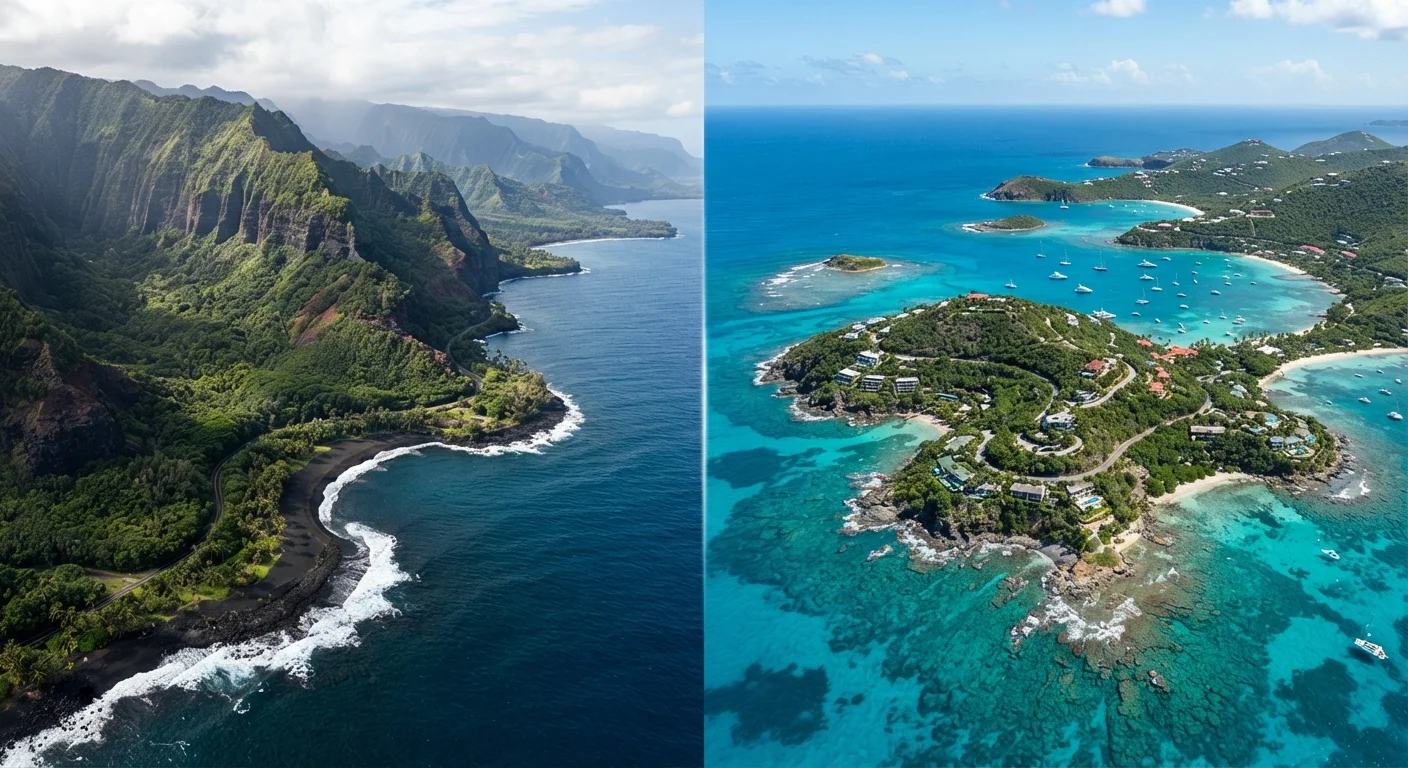
This is where the two destinations diverge most sharply. Hawaii is a geologically active Pacific archipelago where each island has its own distinct character. The Big Island hosts active lava flows at Hawai'i Volcanoes National Park, while Kauai's Na Pali Coast features dramatic 4,000-foot sea cliffs. Maui offers everything from the moonscape summit of Haleakalā to the lush Road to Hana. Hawaii's sheer landscape variety is unmatched among US destinations.
The USVI operates at a completely different scale. Its islands are smaller-St. John, for example, covers just 20 square miles-and the environment is quintessentially Caribbean: gentle hillsides, white and powdery beaches, and famously calm, clear turquoise water. Around two-thirds of St. John is protected as Virgin Islands National Park, preserving both its beaches and coral reefs. The snorkeling at Trunk Bay is consistently cited among the Caribbean's finest.
~20 sq mi
Size of St. John, USVI
St. John is among the smallest US national park host islands, with roughly two-thirds of its land federally protected.
6 main islands
Visitor-accessible Hawaiian islands
Oahu, Maui, Kauai, the Big Island, Molokai, and Lanai each offer distinct landscapes and experiences for travelers.
~4,000 ft
Height of Kauai's Na Pali sea cliffs
The Na Pali Coast on Kauai's north shore features some of the tallest and most dramatic coastal cliffs in the United States.
Neither destination is better in an absolute sense-they simply offer different things. If geological drama and variety matter to you, Hawaii wins decisively. If pristine Caribbean reef ecosystems and calm anchorages are the goal, the USVI delivers.
Culture, History, and Local Character
Hawaii's cultural identity is rooted in Native Hawaiian tradition and a multicultural Pacific heritage shaped by waves of Japanese, Filipino, Chinese, and Portuguese immigration. Travelers encounter this through language (Hawaiian words appear on street signs and in everyday speech), food (plate lunches, poke, malasadas), hula performances, and sites of deep historical significance like Pearl Harbor and the royal palace of Iolani. The aloha spirit-a genuine cultural value, not just a tourism slogan-shapes how locals and visitors interact.
The USVI carries a Caribbean and Danish colonial history. St. Thomas was a major colonial trading post, and Christiansted on St. Croix retains a well-preserved Danish colonial townscape now recognized as a National Historic Site. The territory's culture blends African, European, and Caribbean influences, reflected in its food (conch fritters, johnnycakes, fungi), music (quelbe is the official folk music), and the relaxed pace of island life. English is the primary language throughout.
USVI Entry and Travel Verification
While US citizens do not need a passport to visit the US Virgin Islands, airlines may require a government-issued photo ID. Entry requirements, customs rules, and any travel advisories can change. Always verify current requirements with the US State Department and your carrier before traveling.
For readers who enjoy extended immersion in a place's culture and daily rhythms-rather than a packed itinerary-it's worth reading about long-term travel versus living abroad to think through how destination depth shapes the experience differently.
Which Destination Fits Your Trip?
The honest answer is that Hawaii and the USVI rarely compete for the same traveler. Hawaii suits those with more time, a higher travel budget, and a desire for landscape variety and cultural depth. Its size rewards longer stays and multi-island exploration. The USVI suits travelers who want an uncomplicated tropical escape-beautiful beaches, easy water activities, and a manageable footprint-especially those departing from the eastern US.
Both destinations have well-developed tourism infrastructure, though Hawaii's scale means more options at every price point. The USVI is intimate enough that repeat visitors often develop a genuine familiarity with specific bays, restaurants, and communities. Consider your flight origins, available trip length, and what draws you to a tropical destination in the first place-those three factors will almost always point you clearly in one direction.