The Core Safety Difference: Conflict Points and Speed
The safety gap between roundabouts and traditional intersections comes down to two engineering fundamentals: the number of conflict points and vehicle speed at the moment of impact.
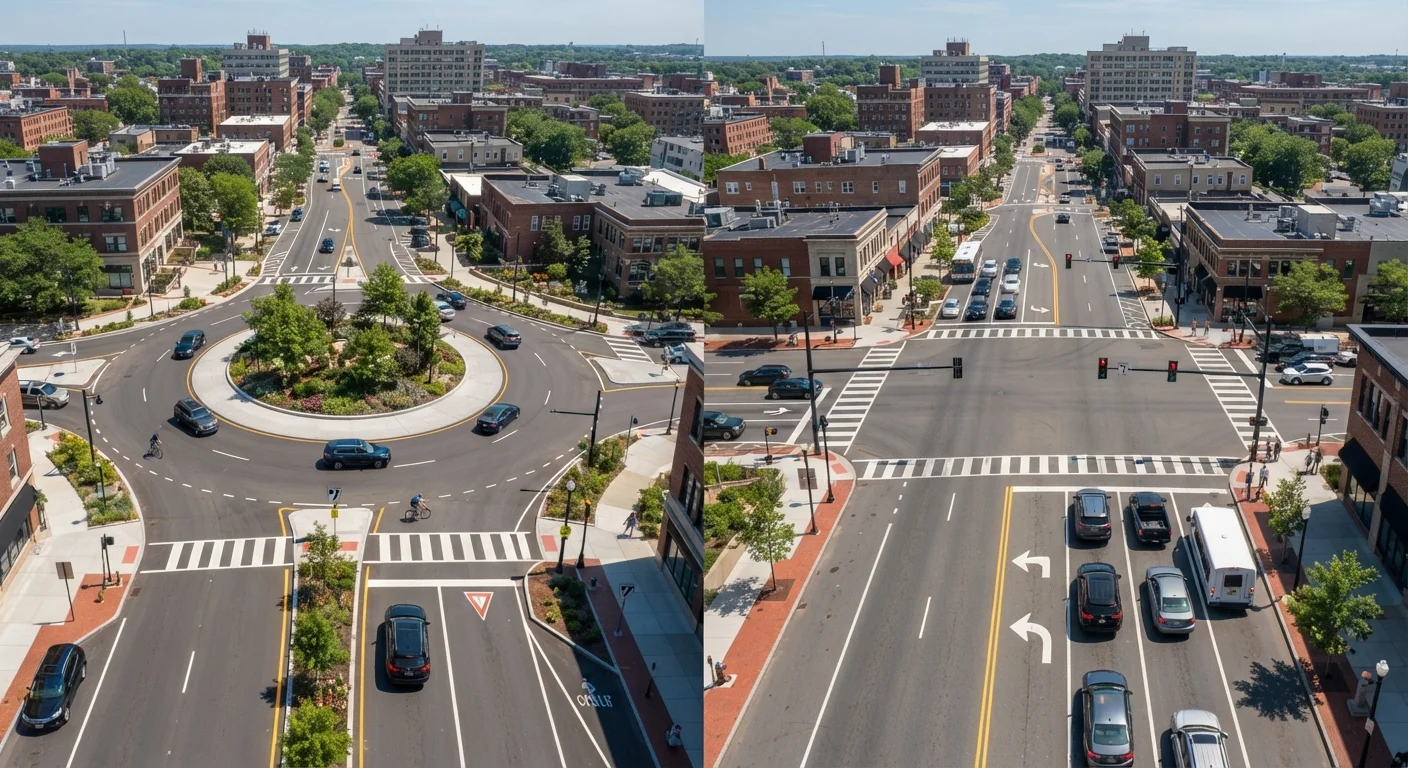
A standard four-way signalized intersection has 32 potential conflict points - places where vehicle paths can cross, merge, or diverge. A comparable roundabout reduces that number to eight. Fewer conflict points means fewer opportunities for crashes to occur.
Speed matters just as much. Vehicles entering a roundabout must slow to roughly 15-25 mph to navigate the curve. At a traditional intersection, drivers can approach - and sometimes run - at 40-50 mph. The energy released in a crash scales with the square of speed, so even modest speed reductions translate into dramatically lower injury severity.
| Criterion | Roundabout | Traditional Intersection |
|---|---|---|
| Conflict points (4-way) | ~8 | ~32 |
| Typical approach speed | 15-25 mph | 30-50 mph |
| Fatal crash reduction (vs. stop-controlled) | ~90% fewer (FHWA data) | Baseline |
| Head-on & right-angle crashes | Virtually eliminated | Primary crash types |
| Pedestrian crossing clarity | Less predictable | Dedicated signal phases |
| Traffic flow (balanced volume) | Continuous, fewer stops | Cyclic stops at red lights |
| Large vehicle compatibility | Varies by design | Generally accommodated |
| Emergency vehicle access | Driver-dependent yielding | Signal pre-emption available |
These principles explain why the Federal Highway Administration's research has found roundabouts to be among the most effective intersection safety countermeasures available, particularly for eliminating the right-angle (T-bone) and head-on crash types that cause the most fatalities.
Where Traditional Intersections Still Hold Their Own
Despite the safety data, traditional intersections aren't simply obsolete. They serve specific conditions well and remain the practical standard across most of the US road network.
High-volume pedestrian corridors benefit from signal control. A dedicated walk phase gives people on foot a predictable, protected window to cross - something that is harder to guarantee in a roundabout, where vehicles are continuously circulating. Accessibility advocates have also raised legitimate concerns about roundabouts for visually impaired pedestrians, who rely on audible signals and clear crossing cues that traditional intersections provide by default.
Certain high-volume arterials also favor signal control. When traffic demand is uneven - heavy on one approach and light on others - signal timing can be tuned to move vehicles efficiently. Roundabouts are self-regulating by design, which works well under balanced flow but can become congested when one approach is dominant.
~90%
Reduction in fatal crashes at roundabouts
According to the Federal Highway Administration, roundabouts reduce fatal crashes by approximately 90% compared to stop- or signal-controlled intersections.
~75%
Reduction in injury crashes at roundabouts
The same FHWA research indicates injury crashes fall by roughly 75% when traditional intersections are converted to roundabouts.
32 vs. 8
Conflict points: traditional vs. roundabout
Traffic engineering analysis shows a standard four-way intersection has 32 vehicle conflict points; a roundabout reduces this to approximately 8.
Emergency vehicle access is another consideration. Signals can be pre-empted to clear a path instantly; a roundabout relies on circulating drivers yielding voluntarily, which introduces variability. Just as poor merging technique creates risk on entrance ramps, driver behavior inside a roundabout matters - and predictability is harder to enforce there than at a red light.
The Familiarity Factor and What It Means for Drivers
American drivers are less experienced with roundabouts than their counterparts in the UK, France, or Australia, where circular intersections have been standard for generations. That unfamiliarity shows up in crash data at newly installed roundabouts - there is often a brief adjustment period during which minor crashes, particularly from incorrect yielding, tick upward before falling sharply as local drivers adapt.
The Adjustment Period Is Real but Short
Studies of newly converted intersections in the US have found that driver error rates - particularly failure-to-yield incidents - tend to spike briefly after a roundabout opens, then drop well below pre-conversion crash levels within one to two years. The data suggest this is a learning curve, not an inherent flaw in the design. Communities that install roundabouts should anticipate a short transition period rather than treating early incidents as evidence the design isn't working.
The practical takeaway for drivers: when approaching a roundabout, yield to traffic already in the circle, choose your lane before entering, maintain a steady speed, and signal when exiting. These habits eliminate most roundabout errors. At a traditional intersection, the leading causes of fatal crashes are red-light running and left-turn conflicts - behaviors that signal compliance and patience directly address.
Understanding the design logic behind each intersection type makes you a more confident, adaptive driver regardless of which one you encounter.