
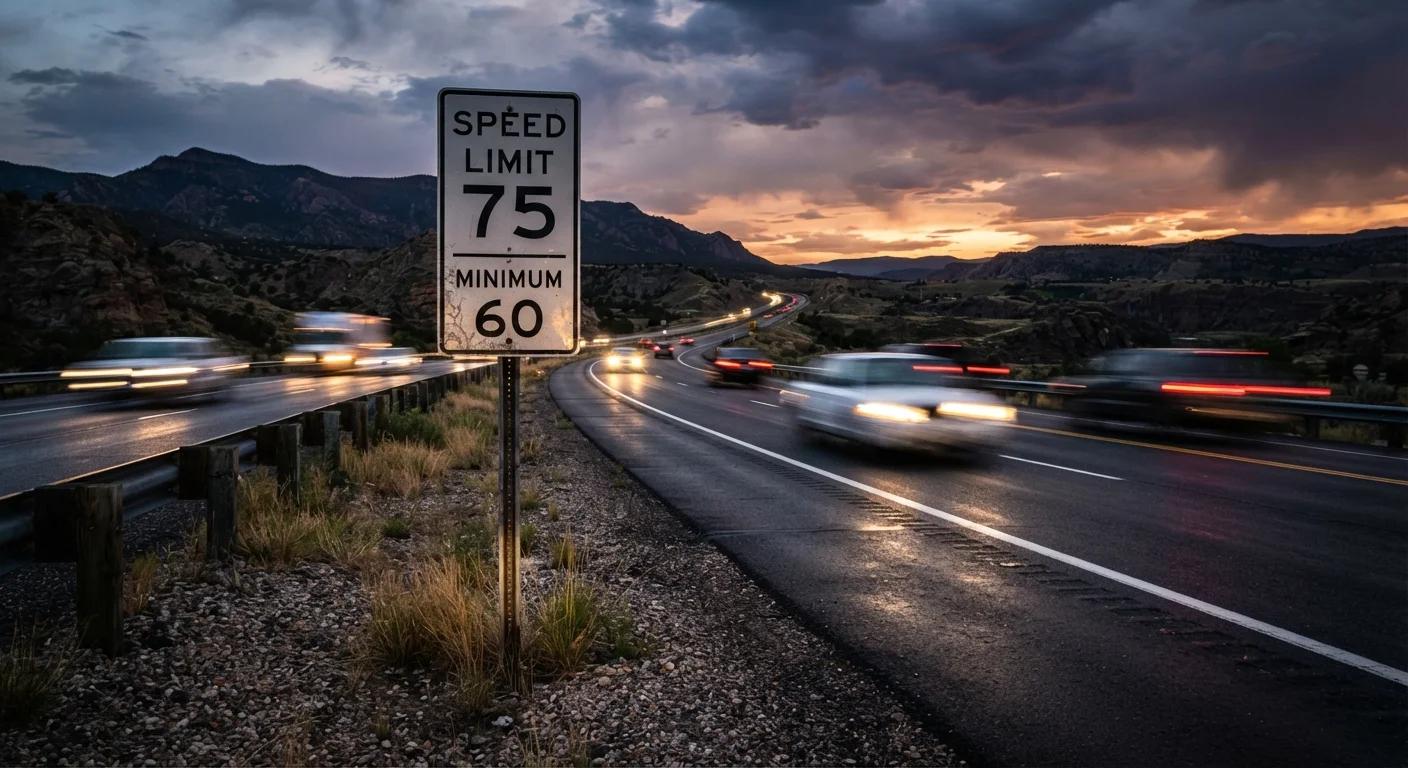
Why Speed Myths Are a Safety Problem
Most drivers consider themselves law-abiding when they stay at or near the posted speed limit. That's reasonable - but it can also breed overconfidence. Speed limit signs communicate the legal boundary for normal conditions, not a universal guarantee of safety. When drivers treat the number on that sign as a green light regardless of weather, traffic, or road geometry, the results can be serious.
Misconceptions about speed are stubbornly persistent, partly because they feel intuitively correct. Understanding where those intuitions break down is one of the most practical things a driver can do. The myth-fact pairs below tackle the most common ones directly. For a related look at how spatial awareness affects crash risk, see our coverage of following distance.
Myth
If I'm driving at the speed limit, I'm driving safely no matter what.
Fact
The speed limit is a legal ceiling for ideal conditions - not a safety guarantee for all situations.
Speed limits are established for dry roads, adequate visibility, and normal traffic flow. When any of those conditions change - rain, fog, heavy congestion, road construction - the safe speed drops below the posted number. A driver doing exactly 65 mph in dense fog or on black ice is operating dangerously, regardless of legal compliance. Adjust speed to match actual conditions, not just the sign.
Myth
Going slightly over the speed limit is fine because everyone does it.
Fact
Speed uniformity in traffic matters, but even modest speed increases meaningfully raise stopping distance and crash severity.
While traffic engineering does consider prevailing speeds, the fact that speeding is common doesn't make it low-risk. Each additional 5 mph increases stopping distance and the energy released in a collision. A vehicle going 10 mph over the limit in a 40 mph zone needs significantly more distance to stop than one traveling at the limit - and has far less time to react to a hazard that appears suddenly.
Myth
Slower traffic is more dangerous - faster is safer because it reduces exposure time.
Fact
Higher speed increases crash risk and severity; reducing time on the road does not offset this.
This myth conflates total exposure time with per-mile risk. While driving fewer miles does statistically reduce overall crash probability, traveling those miles faster increases the chance of a crash on any given trip. Reaction time is fixed - roughly 1.5 seconds for most drivers - so at higher speeds, a vehicle covers more ground before the driver even begins to brake. Crash data consistently links speed to both likelihood and severity of injury.
Myth
I know this road well, so I can safely drive it faster.
Fact
Familiarity with a road reduces navigational uncertainty but doesn't change the physics of speed or the unpredictability of other drivers and hazards.
A driver who has traveled a road hundreds of times may anticipate curves and intersections better - but they cannot anticipate a deer crossing, a child on a bicycle, or a car that runs a stop sign. Familiarity can actually increase overconfidence, leading drivers to pay less attention. Road conditions also change: yesterday's dry pavement may be wet or frost-covered today.
Myth
Modern cars are so safe that speed is less of a factor in serious crashes.
Fact
Advanced safety technology has improved survivability in many crashes, but it cannot overcome the fundamental physics of high-speed impacts.
Features like automatic emergency braking, lane-keeping assist, and crumple zones have meaningfully reduced injury in certain crash types. However, these systems have operational limits - many are calibrated for lower-speed scenarios - and none of them eliminate crash risk at high speeds. A vehicle's structural integrity can only absorb so much energy before occupant safety is compromised. Technology is a supplement to safe driving behavior, not a substitute.
What Actually Determines a Safe Speed
Safe speed is a function of multiple overlapping factors: sight distance, road surface condition, vehicle load and tire condition, traffic density, and the predictability of other road users. Speed limits are set using engineering studies - often based on the 85th-percentile speed of free-flowing traffic under ideal conditions - but those studies can't account for every scenario a driver will encounter.
~50%
Increase in stopping distance on wet pavement
Driver safety education materials widely cite wet roads as extending braking distances by roughly half compared to dry conditions at the same speed.
4x
Kinetic energy at 60 mph vs. 30 mph
Because kinetic energy scales with the square of velocity, doubling speed quadruples the energy a vehicle carries into a collision.
~1.5 sec
Average driver reaction time
At 60 mph, a typical driver travels roughly 132 feet before even beginning to brake - nearly half the length of a football field.
Rain, for example, can extend stopping distances by 50% or more compared to dry pavement, according to general driver education research. Fog, glare, construction zones, and wildlife crossings all require speeds well below what the sign permits. Recognizing this gap between legal and situationally safe is the core habit that separates cautious drivers from overconfident ones.
Construction and School Zones Require Extra Caution
Posted speed limits in work zones and school zones are often significantly lower than the surrounding roadway limit - and for good reason. Reduced sight lines, workers on foot, children crossing unexpectedly, and equipment entering the road all require slower speeds and heightened attention. Many states impose higher fines and legal penalties for speeding in these zones. Always treat these areas as requiring more caution than the sign alone conveys.
Speed is also a factor in crash severity, not just crash likelihood. Physics dictates that kinetic energy - and therefore crash force - increases with the square of velocity. A vehicle traveling at 60 mph carries roughly four times the energy of one at 30 mph. That relationship doesn't change because a sign says 60 is permitted.
Building Habits That Reflect Reality
Correcting these myths isn't about driving slower everywhere - it's about driving at a speed appropriate to actual conditions at any given moment. That means scanning ahead, adjusting for weather, increasing following distance at higher speeds, and resisting the pressure to match surrounding traffic when conditions are deteriorating.
The same critical thinking that helps people question assumptions in other areas - whether it's investment decisions or travel planning - applies directly to how drivers assess risk on the road. Confident, informed driving means using posted limits as a starting point, not an endpoint.
Speed Is a Factor in the Majority of Fatal Crashes
The National Highway Traffic Safety Administration (NHTSA) has consistently identified speeding as a contributing factor in a significant proportion of traffic fatalities each year in the United States. This includes driving at speeds inappropriate for conditions - not just exceeding the posted limit. Treating speed as a flexible variable rather than a fixed rule is one of the highest-impact decisions a driver makes every trip.