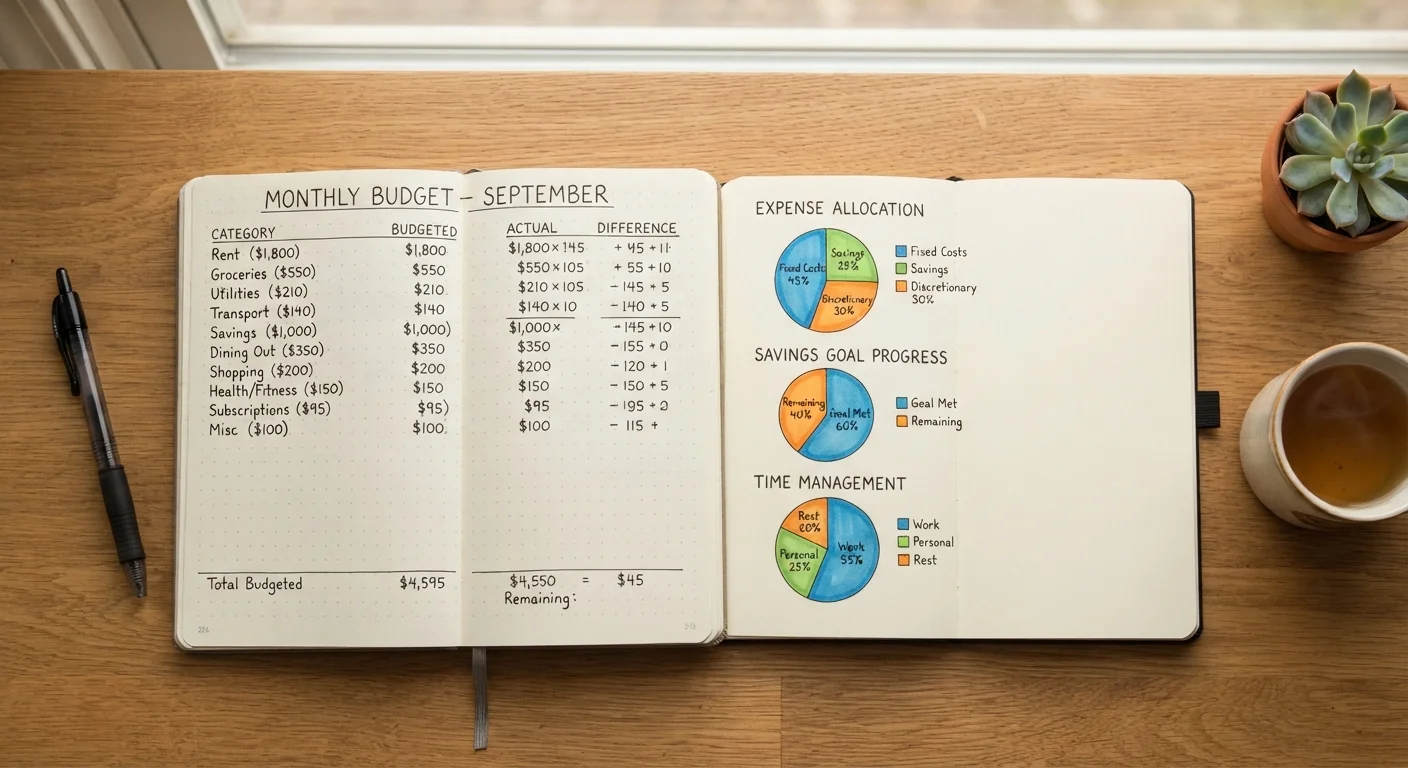

Why a Monthly Budget Audit Matters
Most budgets are built with good intentions and abandoned within weeks. The missing piece is usually the review - a deliberate, scheduled check-in to measure what actually happened against what you planned. A monthly budget audit closes that loop.
Unlike the broad task of creating a budget from scratch, an audit is focused and fast. You're not rebuilding your financial plan; you're evaluating last month's performance and making targeted corrections before the next cycle begins. Done consistently, this habit is one of the most reliable ways to make budgeting actually stick. If you've struggled with follow-through, our guide on why budgets fail in month two explores the patterns behind that - and how to break them.
This checklist walks you through the full end-of-month review process: gathering your records, categorizing spending, spotting trends, and updating your plan for next month.
Bank and Credit Card Statements
The primary source of your actual spending data for the month - download PDFs or access online portals.
Budgeting Spreadsheet or App
Where your planned budget lives; used to compare targets against actual spending during the audit.
Calculator
Useful for quickly totaling category spending and computing your net savings rate.
Printed or Digital Checklist
A physical or digital copy of this checklist to mark off as you work through each step.
Notebook or Journal
For writing observations, patterns, and goals that emerge during the audit - useful for month-over-month comparison.
How to Use This Checklist
Set aside 30 to 60 minutes in a low-distraction environment, ideally within the first two days of the new month. Work through each group sequentially - the later steps build on what you discover in the earlier ones. Mark items complete as you go; the physical act of checking things off reinforces the habit.
If you're just getting started and don't yet have an established monthly budget to compare against, our complete household budgeting resource walks you through building one from the ground up. For readers deciding between budgeting frameworks, zero-based vs. 50/30/20 budgeting breaks down which approach may suit your situation.
Your Budget Is a Living Document
A budget that never changes is a budget that stops working. Every monthly audit should result in at least minor updates to your plan - whether that's adjusting a category limit, adding an irregular expense, or revising a savings goal. Treating your budget as fixed ignores the reality that life and spending patterns shift constantly. The audit's job is to keep your plan aligned with your actual life.
Gather Your Records
Review Fixed Expenses
Analyze Variable Spending
Assess Savings and Debt Payments
Spot Patterns and Trends
Update Next Month's Budget
What to Do After the Audit
An audit without action is just observation. Once you've worked through the checklist, update next month's budget to reflect what you learned. If a category was consistently over, either reduce spending in that area or reallocate funds from elsewhere - but be honest about which is realistic.
Note one or two specific patterns to watch. You don't need to overhaul everything at once. Small, deliberate corrections compounded over several months produce more lasting results than aggressive one-time resets.
Freelancers and gig workers face the additional complexity of income variability. If your earnings fluctuate, the strategies in our article on budgeting on an irregular income can help you adapt this audit process to months when revenue is unpredictable.
Schedule your next audit now - put it on your calendar before you close this tab. Consistency, not perfection, is what moves the needle.
Don't Skip the Audit When the Month Was Bad
It's tempting to avoid reviewing months where spending went off the rails. Skipping the audit, however, means losing the clearest signal about what needs to change. An uncomfortable review is more valuable than no review at all - the patterns you identify in a difficult month are often the most instructive. Approach the process with curiosity rather than judgment.
This article is for general informational and educational purposes only and does not constitute personalized financial advice. Consult a qualified financial professional for guidance specific to your circumstances.