How Dollar-Cost Averaging Works
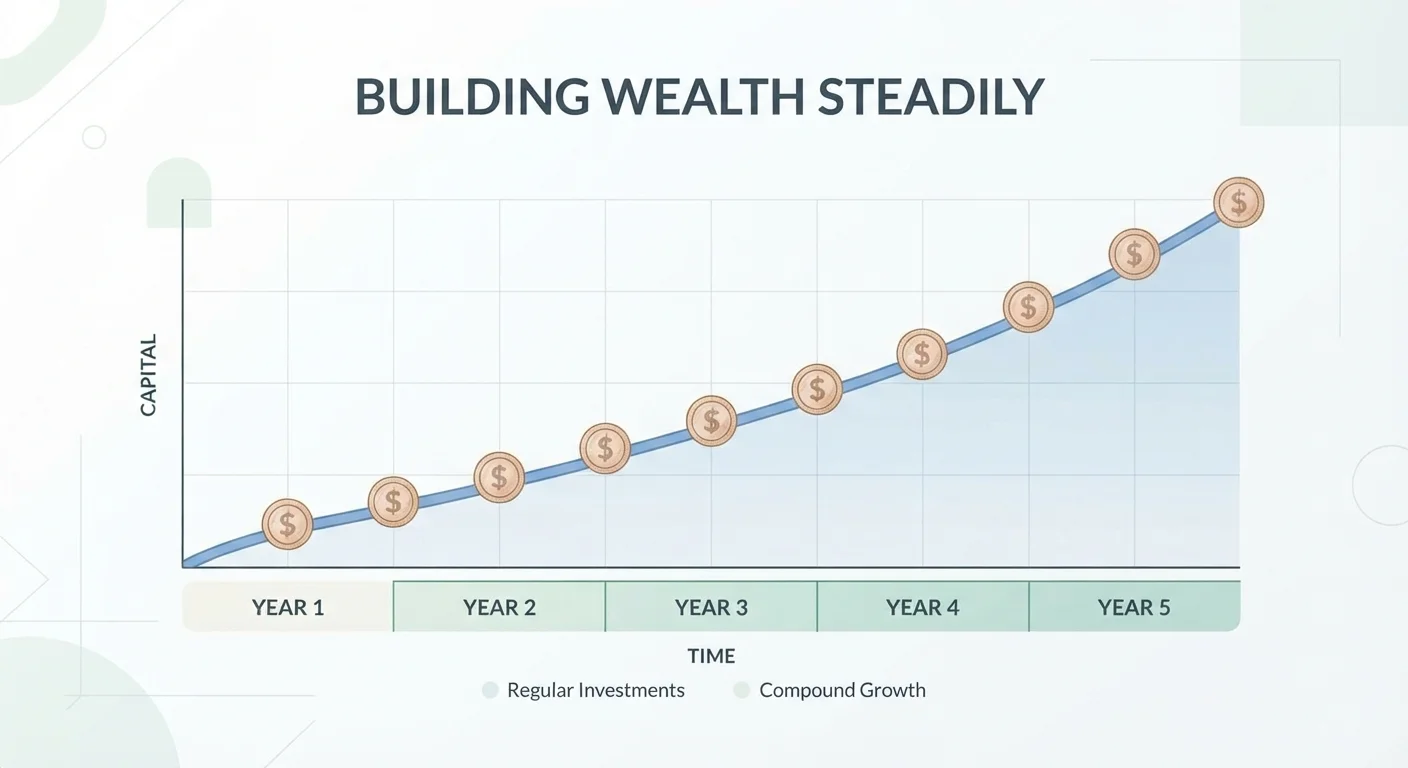
The mechanics of dollar-cost averaging are straightforward. You choose an amount-say, $100-and invest it on a fixed schedule, such as the first of every month. That $100 buys more shares when the price is low and fewer shares when the price is high. Over multiple purchases, your average cost per share is smoothed out across different market conditions.
Consider a simple illustration: if you invest $100 when a share costs $20, you receive 5 shares. The following month, the price drops to $10, and your $100 buys 10 shares. You now hold 15 shares at an average cost of roughly $13.33 each-lower than your first purchase price. This mathematical effect is sometimes called the benefit of buying more at lower prices.
It is worth familiarizing yourself with core investing vocabulary before diving in. Our reference guide to financial terms for new investors covers concepts like expense ratios and diversification that come up frequently alongside DCA discussions.
~$7T
Assets held in US 401(k) plans
According to the Investment Company Institute, US 401(k) plans held approximately $7 trillion in assets as of recent data, with the majority of contributions made through regular payroll deductions-an embedded form of DCA.
~66%
Of the time lump-sum outperforms DCA historically
Vanguard research has found that investing a lump sum immediately outperforms a 12-month DCA strategy roughly two-thirds of the time in historically rising markets.
58%
Of US workers participate in a workplace retirement plan
The Bureau of Labor Statistics reports that a majority of private-sector workers have access to and participate in employer-sponsored retirement plans, most of which use systematic contribution schedules.
Why Investors Use This Strategy
The primary appeal of DCA is behavioral, not purely mathematical. Timing the market-buying at the exact low and selling at the exact high-is extraordinarily difficult, even for professional fund managers. DCA sidesteps this challenge by removing the need to make that call at all. You invest on schedule, regardless of headlines or short-term volatility.
This consistency also builds a savings habit. By treating a regular investment contribution like a fixed bill, many people find it easier to stay on track. If you are also working to build a broader personal savings plan, DCA can serve as one reliable component within that structure.
“The stock market is a device for transferring money from the impatient to the patient.”
— Warren Buffett, Chairman and CEO, Berkshire Hathaway; widely cited investor and business leader
DCA in Practice: Common Scenarios
Many Americans are already using DCA without calling it that. If your employer deducts a set amount from each paycheck and deposits it into a 401(k), that is dollar-cost averaging in action. The same principle applies to automatic monthly contributions to an IRA or a taxable brokerage account.
For those just beginning their investing journey, even modest regular contributions can establish a productive pattern. Our article on investing when you have little to spare explains how fractional shares and low account minimums have made consistent investing accessible to a wider range of people.
Automate to Stay Consistent
The most effective way to stick with a DCA strategy is to automate it. Setting up an automatic transfer on payday means you invest before you have a chance to spend the money elsewhere. Most brokerage and retirement accounts allow you to schedule recurring contributions with no manual action required after setup.
Limitations and Risks to Understand
Dollar-cost averaging is not a shield against loss. If an asset's value declines steadily over a long period, regular contributions will accumulate losses, not gains. DCA works most effectively when markets trend upward over time, which has historically been the case for broad diversified index funds-though past performance does not guarantee future results.
There are also practical cost considerations. Some investment accounts charge transaction fees per trade. If each DCA contribution triggers a fee, frequent small purchases can erode returns. It is worth understanding the fee structure of any account before setting up automatic contributions. Understanding how fixed versus variable expenses fit into your budget can also help you determine how much you can realistically commit to a DCA plan without straining your finances.
This article is for general informational and educational purposes only and does not constitute personalized investment, tax, or financial advice. Consult a qualified, licensed financial professional before making decisions based on your individual situation.