
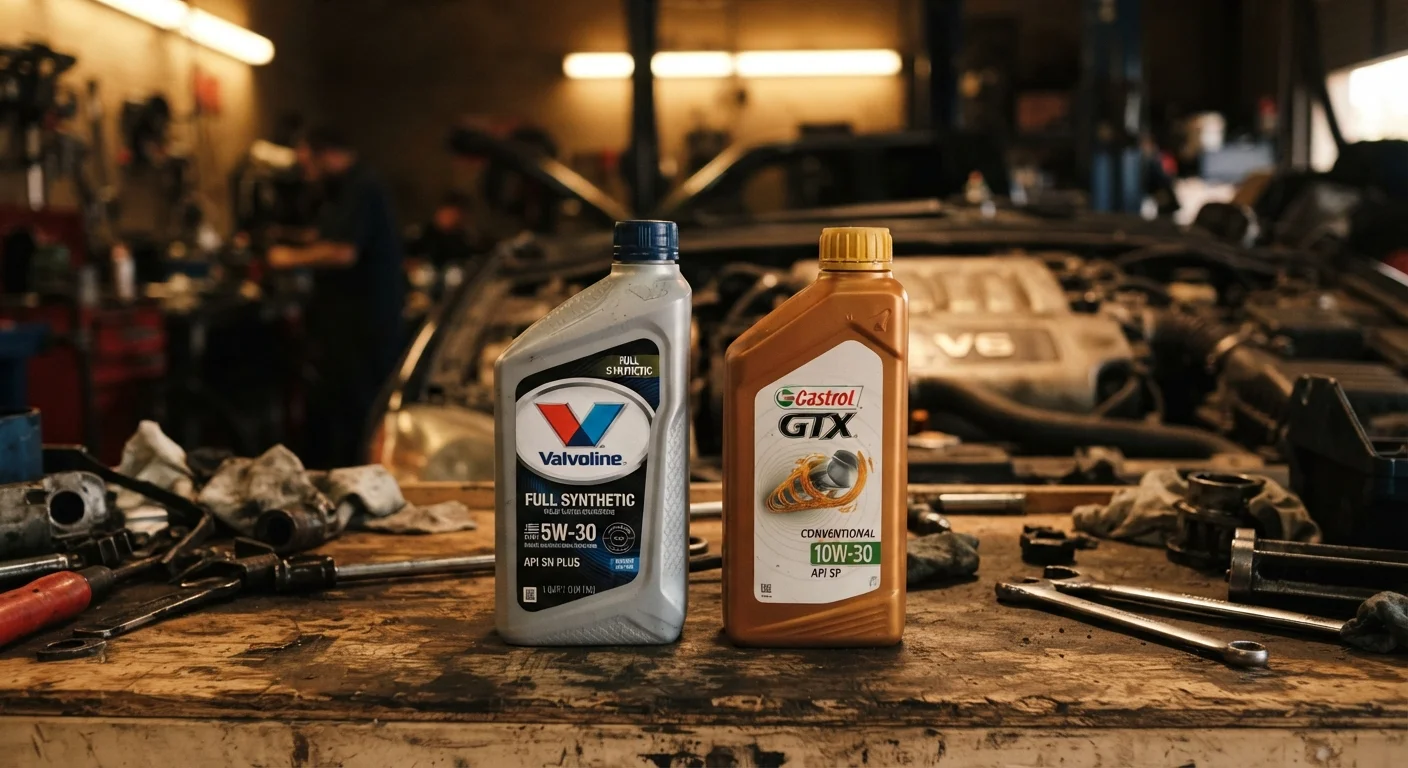
What Sets These Two Oils Apart
At its core, the difference comes down to origin and molecular consistency. Conventional motor oil is derived from crude petroleum that's been refined to remove impurities. The result is an effective lubricant, but one with a naturally variable molecular structure. Synthetic motor oil, by contrast, is chemically engineered - its molecules are built to a uniform size and shape, which delivers more predictable behavior under heat, pressure, and cold.
This isn't just a marketing distinction. Synthetic oil's uniform molecules reduce internal friction more efficiently, break down more slowly under high temperatures, and flow more readily in sub-zero conditions. Conventional oil can still do the job in the right application - but it's working with less molecular precision. For a broader look at how engine oil fits into the full picture of under-hood fluids, see our guide to every fluid under the hood.
| Criterion | Synthetic Motor Oil | Conventional Motor Oil |
|---|---|---|
| Origin | Chemically engineered molecules | Refined from crude petroleum |
| Typical change interval | 7,500-15,000 miles | 3,000-7,500 miles |
| Cost per quart | Higher (approx. 2-4x more) | Lower upfront cost |
| Cold-weather performance | Flows readily at low temps | Can thicken in extreme cold |
| High-heat stability | Resists breakdown under heat | More prone to thermal breakdown |
| Best engine type | Modern, turbocharged, high-performance | Older, simpler, naturally aspirated |
| Environmental impact | Fewer changes, less waste oil | More frequent disposal cycles |
Performance, Longevity, and Cost: The Real Trade-Offs
Synthetic oil's engineered stability translates into tangible durability. Most full-synthetic formulations are rated for 7,500 to 15,000 miles between changes, depending on the vehicle and driving conditions. Conventional oil, meanwhile, typically needs to be replaced every 3,000 to 7,500 miles - a range that has widened over the decades as refining processes improved.
~2x
Longer drain interval vs. conventional oil
Full synthetic formulations commonly carry manufacturer approvals for drain intervals roughly double those of conventional oil under normal driving conditions.
3,000 mi
Legacy conventional oil change interval
The 3,000-mile rule was standard guidance for decades but is now considered excessive for most modern engines and oil formulations by many automotive engineers.
Up to 40°F
Cold-start protection temperature advantage
Synthetic oils can maintain pumpable viscosity at temperatures significantly lower than many conventional oils, reducing dry-start engine wear in cold climates.
The cost comparison isn't as simple as price-per-quart. Synthetic oil typically costs two to four times more per quart than conventional, but if it lasts twice as long between changes, the annual maintenance spend can be similar or even lower. Factor in reduced engine wear over time, and the value proposition for synthetic oil strengthens considerably - particularly for engines that run hot or experience frequent cold starts.
For a deeper look at how interval science actually works, our breakdown of oil change intervals explains what really drives the right schedule for your vehicle.
How to Decide What's Right for Your Engine
The single most reliable guide is your vehicle's owner's manual. Manufacturers specify oil type and viscosity grade (such as 5W-30 or 0W-20) based on engine design tolerances - not preference. If your manual calls for full synthetic, using conventional oil may not provide adequate protection and could void warranty coverage in some cases.
Viscosity Grade Matters Too
Oil type (synthetic vs. conventional) is only part of the equation - viscosity grade is equally important. A 0W-20 synthetic is not interchangeable with a 5W-30 conventional in terms of engine protection. Always match the viscosity grade specified in your owner's manual, regardless of which oil type you choose. Using the wrong viscosity can affect oil pressure and engine wear, particularly on cold starts.
Beyond the manual, consider your driving pattern. Stop-and-go city driving, extreme weather, frequent short trips (where the engine never fully warms up), and towing all put more stress on oil and favor synthetic's greater stability. Mild highway commuting in a temperate climate on an older, naturally aspirated engine is a reasonable case for conventional oil.
One common question is whether switching between oil types causes problems. Generally, modern engines handle the transition fine - but always verify with your manufacturer's guidance and never mix oil types in the same fill unless you're topping off temporarily. If you're also weighing larger vehicle decisions, the same principle of matching needs to specs applies - much like the trade-offs covered in our new vs. used car comparison.