How Researchers Compare Two Very Different Impairments
Comparing drowsy driving to drunk driving is not a rhetorical device - it's a research methodology. Starting in the late 1990s, scientists began using standardized driving simulations to measure how sleep deprivation affects performance on the same metrics used to assess alcohol: reaction time, lane deviation, gap acceptance, and hazard recognition.
A foundational series of studies, including work published by researchers at the University of New South Wales, found that sustaining wakefulness for approximately 17-19 hours produced driving errors equivalent to those observed at a blood alcohol concentration (BAC) of around 0.05%. Extending wakefulness to roughly 24 hours pushed simulated impairment to a level comparable to a BAC of 0.10% - above the legal limit of 0.08% in every U.S. state.
These findings don't mean fatigue and alcohol are identical in mechanism. They mean the outcome - degraded driving performance - overlaps significantly. Understanding why each impairment works the way it does clarifies both the similarities and the critical differences.
~0.08%
BAC equivalent after ~20 hrs awake
Research published in peer-reviewed sleep science journals has found that roughly 20 hours of wakefulness produces driving impairment comparable to a legally drunk driver.
~100,000
Police-reported drowsy-driving crashes annually
NHTSA estimates approximately 100,000 police-reported crashes per year involve drowsy driving, though researchers note the true figure is likely higher due to underreporting.
3-4×
Crash risk increase with severe sleepiness
Studies using naturalistic driving data suggest that episodes of severe drowsiness can increase crash or near-crash risk by three to four times compared to alert driving.
Side-by-Side: What the Evidence Shows
Both alcohol and sleep deprivation impair the prefrontal cortex - the brain region responsible for judgment, planning, and impulse control. Both slow neural transmission and reduce the speed and accuracy of hazard response. But the mechanisms diverge in important ways.
| Criterion | Drowsy Driving | Drunk Driving |
|---|---|---|
| Primary mechanism | Sleep pressure on prefrontal cortex | CNS depressant slowing neural signals |
| Reaction time impact | Significantly slowed; worsens with duration | Significantly slowed; dose-dependent |
| Self-awareness of impairment | Typically poor; drivers underestimate deficit | Variable; physical cues more apparent |
| Unique risk factor | Microsleeps (involuntary, undetectable) | Overconfidence and risk-taking behavior |
| Roadside detection | No objective test currently available | BAC measurable via breathalyzer or blood test |
| Legal threshold (US) | No defined legal limit | 0.08% BAC in all 50 states |
| Peak risk window | Midnight-6 a.m.; mid-afternoon | Late night; weekends (behavioral pattern) |
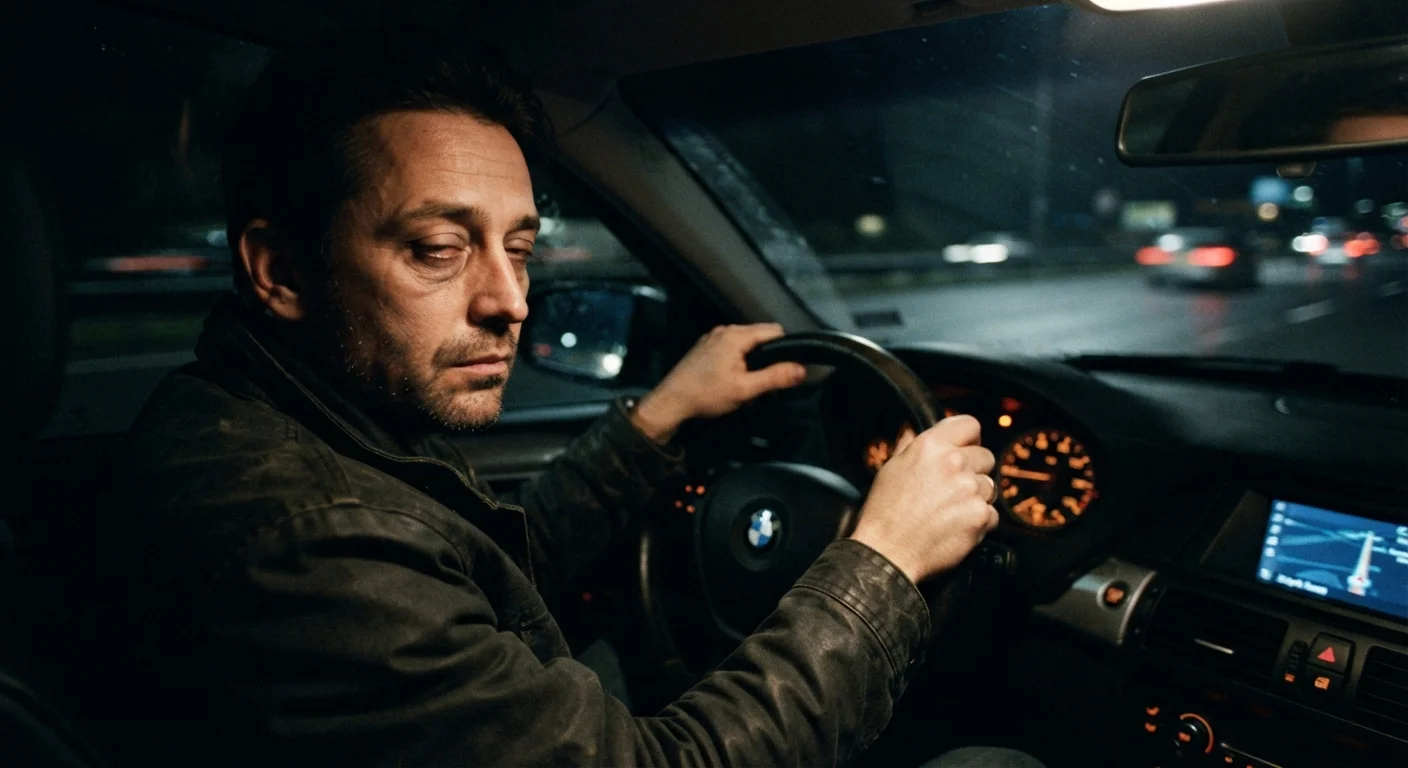
One of the most significant distinctions is the phenomenon of microsleeps: brief, involuntary episodes of sleep lasting one to ten seconds that occur without the driver's awareness. A vehicle traveling at 60 mph covers roughly 88 feet per second - meaning even a three-second microsleep puts a car nearly the length of a basketball court down the road with no one consciously in control. Alcohol does not produce microsleeps; it degrades cognition continuously rather than shutting it off in bursts.
For broader context on how reduced visibility compounds fatigue risk after dark, see our guide to night driving habits for evidence-backed strategies.
The Self-Awareness Problem
Perhaps the most practically dangerous difference between the two impairments is how each affects a driver's ability to recognize their own condition. Research consistently shows that as sleep deprivation deepens, individuals become progressively worse at estimating their own alertness level - a form of metacognitive impairment. Drivers who feel "fine" after sleeping five hours may be operating with reaction times equivalent to someone above the legal alcohol limit.
Alcohol presents a different profile. At low doses, it can produce overconfidence; but overt physical symptoms - slurred speech, coordination problems, visual disturbance - provide external signals that trained observers and roadside sobriety tests can detect. Drowsiness leaves no breath odor, no nystagmus (involuntary eye movement used in field sobriety tests), and no measurable chemical trace.
Why Drowsy Driving Data Is Hard to Pin Down
Unlike alcohol-impaired crashes, which generate a measurable BAC record, drowsy-driving crashes rely on officer judgment and driver self-report for classification. NHTSA and independent researchers broadly agree that official crash counts underrepresent the true scope of fatigue-related incidents. Some studies using in-vehicle monitoring and naturalistic data suggest the actual contribution of drowsiness to serious crashes may be two to three times higher than police records indicate.
This enforcement gap matters. Drunk driving is tracked through BAC testing; fatigue-related crashes are often coded simply as "inattention" in crash reports, which means national statistics on drowsy driving fatalities are widely considered underestimates by researchers at the National Highway Traffic Safety Administration (NHTSA).
Cognitive distraction from phone use shares some of these self-awareness blind spots. Our article on how phones distract drivers even without texting covers the research on that overlapping impairment.
Practical Takeaways for Drivers
The research converges on a few durable, actionable principles. First, there is no safe substitute for adequate sleep before driving - caffeine and cold air reduce perceived sleepiness temporarily but do not restore reaction time or judgment to fully rested levels. Second, drowsiness risk is highest between midnight and 6 a.m. and again in the mid-afternoon, reflecting the body's natural circadian dip. Third, long monotonous roads accelerate fatigue onset regardless of how rested a driver feels at the start of a journey.
If you notice warning signs - yawning repeatedly, difficulty maintaining lane position, missing exits, or struggling to remember the last few miles - the only reliable response is to pull off safely and rest. Planning rest stops every two hours on long trips, or sharing driving duties, reduces risk substantially. For drivers who regularly work irregular hours or overnight shifts, fatigue management deserves the same deliberate attention most people already give to avoiding alcohol before driving.