
What Credit and Debt Actually Mean
Credit is the ability to borrow money now and repay it later, usually with interest. Debt is the outstanding amount you owe as a result of borrowing. Together, they form the foundation of most major financial decisions Americans make - from financing a car to renting an apartment to buying a home.
Lenders - banks, credit unions, and other financial institutions - extend credit based on their assessment of how likely you are to repay. That assessment relies heavily on your credit history: a record of how you have managed debt in the past. Building and maintaining a positive credit history is therefore not just about access to loans; it influences the interest rates you're offered, and sometimes even employment and housing applications.
Credit
The ability to borrow money with a promise to repay it later, typically with interest added.
Credit Score
A three-digit number (300-850 on the FICO scale) that summarizes how reliably you've managed borrowed money. Higher scores indicate lower lending risk.
APR (Annual Percentage Rate)
The yearly cost of borrowing money, expressed as a percentage, that includes both the interest rate and applicable fees.
Credit Utilization Ratio
The percentage of your available revolving credit that you're currently using. A lower ratio generally helps your credit score.
Principal
The original amount of money borrowed, before any interest or fees are added.
Collateral
An asset - such as a home or car - that a borrower pledges to a lender as security; the lender can seize it if the loan is not repaid.
Before diving deeper, it helps to review the vocabulary. See our glossary of key borrower terms for plain definitions of APR, principal, grace period, and more.
How Credit Scores Work
In the US, the most widely used credit scoring model is the FICO score, which ranges from 300 to 850. Scores are calculated from data in your credit reports, maintained by the three major bureaus: Equifax, Experian, and TransUnion. The five components, in order of weight, are:
- Payment history (35%): Whether you pay bills on time
- Amounts owed (30%): How much of your available credit you're using (your utilization ratio)
- Length of credit history (15%): How long your accounts have been open
- Credit mix (10%): Variety of account types (cards, loans, etc.)
- New credit (10%): Recent applications for new credit
Under federal law, you're entitled to a free credit report from each bureau annually at AnnualCreditReport.com - the official, government-authorized site. Reviewing your report regularly lets you catch errors and signs of fraud early.
Set Up Payment Autopay Early
Since payment history accounts for 35% of your FICO score, even a single missed payment can have a meaningful negative impact. Setting up automatic minimum payments ensures you never accidentally miss a due date, even during a busy month. You can always pay more manually on top of the autopay amount.
Types of Debt and Why They Differ
Not all debt is structured the same way, and understanding the distinctions shapes how you manage risk. The most important dividing line is between secured and unsecured debt.
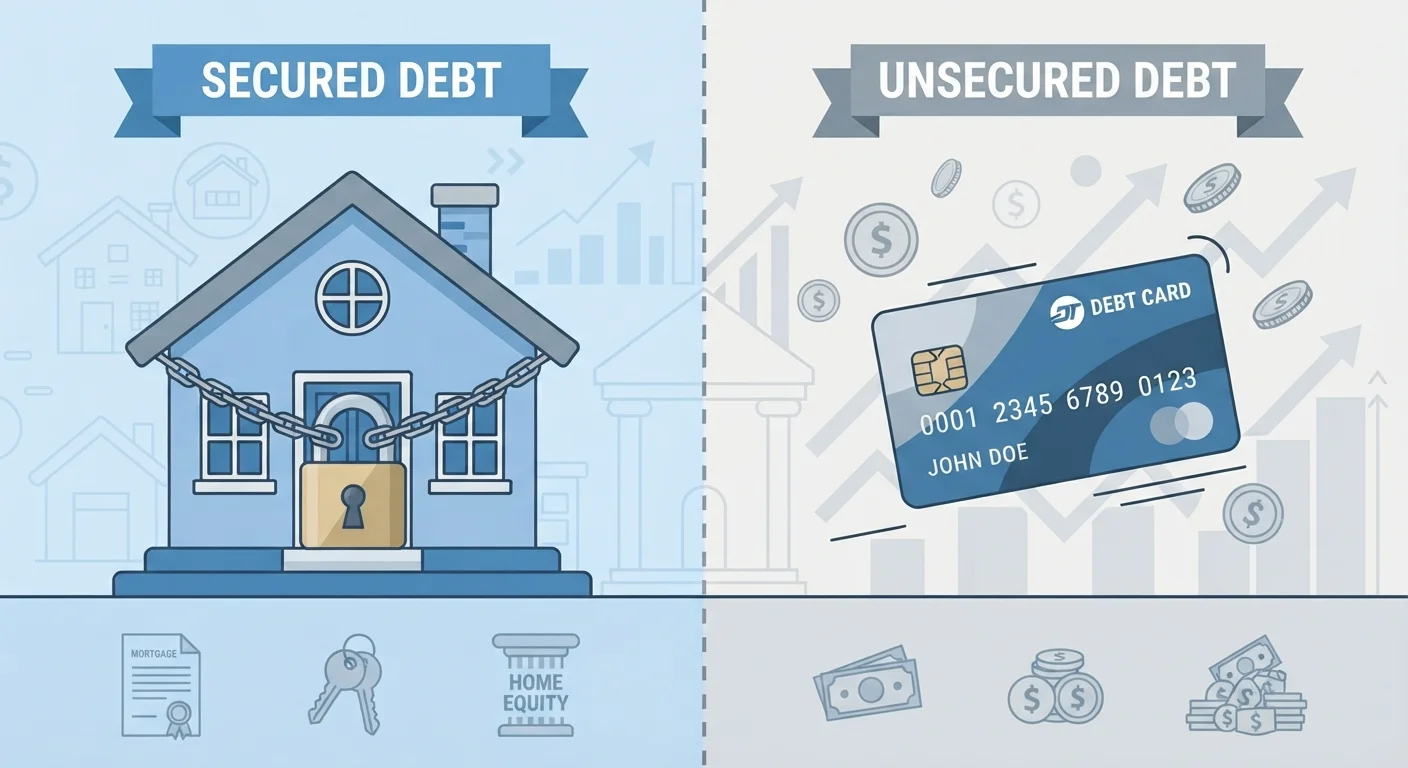
Secured debt is backed by an asset - called collateral - that the lender can claim if you default. Mortgages and auto loans are common examples. Unsecured debt, such as most credit cards and personal loans, carries no collateral. Because the lender takes on more risk, unsecured debt typically comes with higher interest rates.
Debt also differs in repayment structure. Installment loans - like student loans or car loans - have fixed payments over a set term. Revolving credit - like credit cards - lets you borrow up to a limit, repay, and borrow again, with payments that vary based on your balance.
For a detailed breakdown of how these categories affect your financial exposure, see our article on secured vs. unsecured debt.
High Utilization Hurts Scores Fast
Maxing out a credit card - even if you pay it off monthly - can cause a temporary score drop if the high balance is reported before your payment posts. Keeping balances well below your credit limit throughout the month, not just on the due date, protects your utilization ratio.
Interest: The True Cost of Borrowing
Interest is the cost you pay a lender for the use of their money, expressed as a percentage of your outstanding balance. The figure to focus on is the Annual Percentage Rate (APR), which includes both the interest rate and most lender fees, giving you a more accurate picture of the total yearly cost.
For revolving debt like credit cards, interest compounds - meaning unpaid interest is added to your principal, and you then owe interest on that larger amount. This compounding effect is why carrying even a moderate balance can become expensive quickly. For installment loans, an amortization schedule shows exactly how each payment is split between principal reduction and interest - early payments are often mostly interest.
Managing your overall debt load fits within a broader financial plan. Our budgeting basics hub offers practical strategies for tracking spending alongside debt payments.
Responsible Borrowing in Practice
Using credit thoughtfully comes down to a few durable habits. Pay at least the minimum due every month - on time, every time - to protect your payment history. Aim to keep your credit utilization below 30% of your available limit; lower is better. Avoid opening multiple new accounts in a short period, as each hard inquiry can temporarily dip your score.
When debt becomes difficult to manage, there are legitimate options. Nonprofit credit counseling agencies can help you understand a debt management plan. If you're dealing with several high-interest balances, it may be worth learning how debt consolidation actually works - including its trade-offs. And if a past setback has damaged your credit, our guide to rebuilding credit after financial hardship offers realistic, step-by-step guidance.
As your financial knowledge grows, pairing strong debt habits with saving and investing creates long-term stability. The saving and investing hub is a natural next step.
This article is for general informational and educational purposes only and does not constitute personalized financial, legal, or tax advice. Consult a qualified financial professional for guidance specific to your situation.