
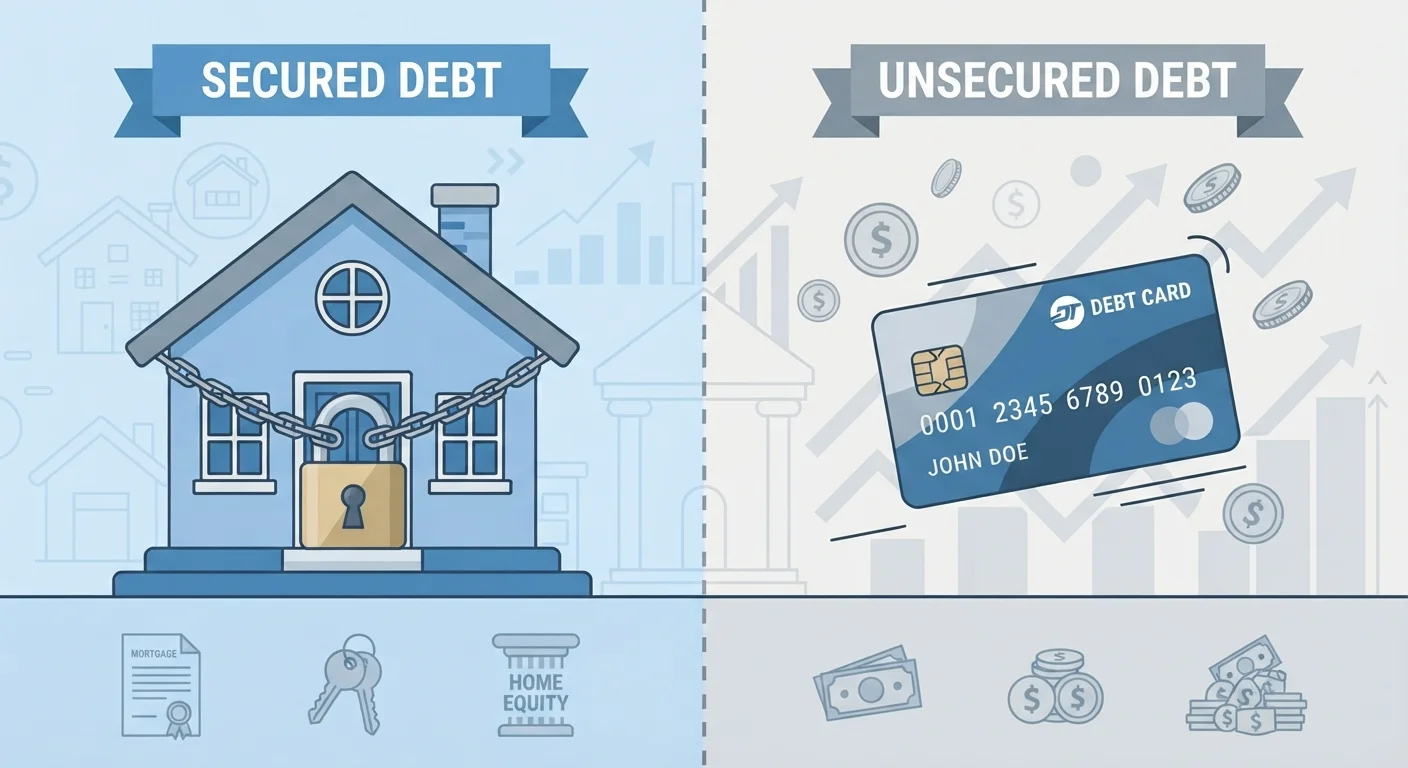
What Makes Debt 'Secured' or 'Unsecured'
The single defining difference between secured and unsecured debt is collateral - an asset pledged to the lender as a condition of the loan. If you stop making payments on a secured debt, the lender has a legal right to seize that specific asset to recover what they're owed.
With secured debt, the collateral is directly tied to the loan agreement. A mortgage is secured by the home being purchased; an auto loan is secured by the vehicle. The lender holds a lien - a legal claim - against the asset until the balance is paid in full. This arrangement reduces the lender's risk substantially, which is why secured loans almost always carry lower interest rates.
Unsecured debt has no such arrangement. When you carry a credit card balance or take out a personal loan, no specific asset is pledged. The lender extends credit based primarily on your creditworthiness - your credit score, income, and debt history. Because the lender has no direct claim on your property if you default, they take on more risk, and that risk is priced into a higher annual percentage rate (APR).
For a grounded overview of how credit works from the start, see our introduction to debt and credit. And if you want to understand the exact terms that appear in any loan agreement, our guide to borrower terminology is a useful companion.
| Criterion | Secured Debt | Unsecured Debt |
|---|---|---|
| Collateral required | Yes - specific asset pledged | No - based on creditworthiness |
| Typical examples | Mortgage, auto loan, HELOC | Credit cards, personal loans, student loans |
| Interest rates | Generally lower | Generally higher |
| Borrowing limits | Typically higher | Typically lower |
| Default consequence | Repossession or foreclosure | Collections, credit damage, potential judgment |
| Lender's risk | Lower - asset backstops the loan | Higher - no direct asset claim |
| Repayment terms | Often longer (years to decades) | Shorter or revolving |
How Default Consequences Diverge
The collateral distinction isn't academic - it becomes critically important when someone can no longer keep up with payments.
When a borrower defaults on a secured debt, the lender's primary remedy is repossession or foreclosure. A mortgage lender can begin foreclosure proceedings, ultimately taking ownership of the home. An auto lender can repossess the vehicle, often with little advance notice depending on state law. This direct recourse makes secured debt consequences fast and tangible.
Defaulting on unsecured debt follows a different path. Without collateral to seize, lenders rely on other mechanisms: damaging your credit score through negative reporting, sending the account to collections, or pursuing a court judgment that could eventually allow wage garnishment or bank account levies. These consequences are serious, but they don't result in immediate loss of a physical asset.
~$12T
Total U.S. mortgage debt outstanding
According to Federal Reserve data, mortgage debt - the largest category of secured consumer debt - consistently represents the dominant share of U.S. household borrowing.
20%+
Average credit card APR in recent years
The Consumer Financial Protection Bureau has reported that average credit card interest rates have climbed significantly, highlighting the cost premium of unsecured revolving credit.
1 in 4
Americans carrying credit card debt month-to-month
Federal Reserve survey data suggests a substantial share of U.S. adults carry revolving unsecured balances, often without full awareness of compounding interest costs.
This is why financial guidance consistently advises prioritizing secured debt payments during a cash-flow crisis. Losing a home or a vehicle carries immediate, life-disrupting consequences that are harder to reverse than a credit score drop - though both deserve attention. If you're thinking about consolidating multiple obligations, our article on what debt consolidation actually changes walks through what the process does - and doesn't - fix.
Interest Rates, Approval, and Risk - by Debt Type
Because lenders price their risk into loan terms, secured and unsecured debt tend to look quite different on paper.
Secured loans typically offer lower interest rates, longer repayment terms, and higher borrowing limits. Mortgages, for instance, are frequently structured over 15 or 30 years - terms that would be unthinkable without the property as collateral. If you're exploring mortgage structures specifically, our comparison of fixed-rate and adjustable-rate mortgages explains how each rate type works over time.
Unsecured debt - particularly credit cards - tends to carry significantly higher APRs and shorter or revolving repayment cycles. Approval depends heavily on your credit profile, and limits are generally lower than comparable secured borrowing. The real cost of carrying revolving balances compounds quickly; our article on making only minimum payments shows what the math looks like over time.
Student Loans: A Nuanced Case
Federal student loans are technically unsecured - no collateral is pledged - but they carry unique characteristics not found in other unsecured debt. They cannot typically be discharged in bankruptcy, and federal loans offer income-driven repayment and forgiveness options unavailable for most other unsecured obligations. This makes them a distinct category worth researching separately before borrowing.
Understanding where each debt type falls on the risk spectrum helps you borrow more intentionally - and respond more strategically if your financial situation changes.
This article is for general informational and educational purposes only and does not constitute personalized financial, legal, or investment advice. Consult a qualified financial professional for guidance specific to your situation.