
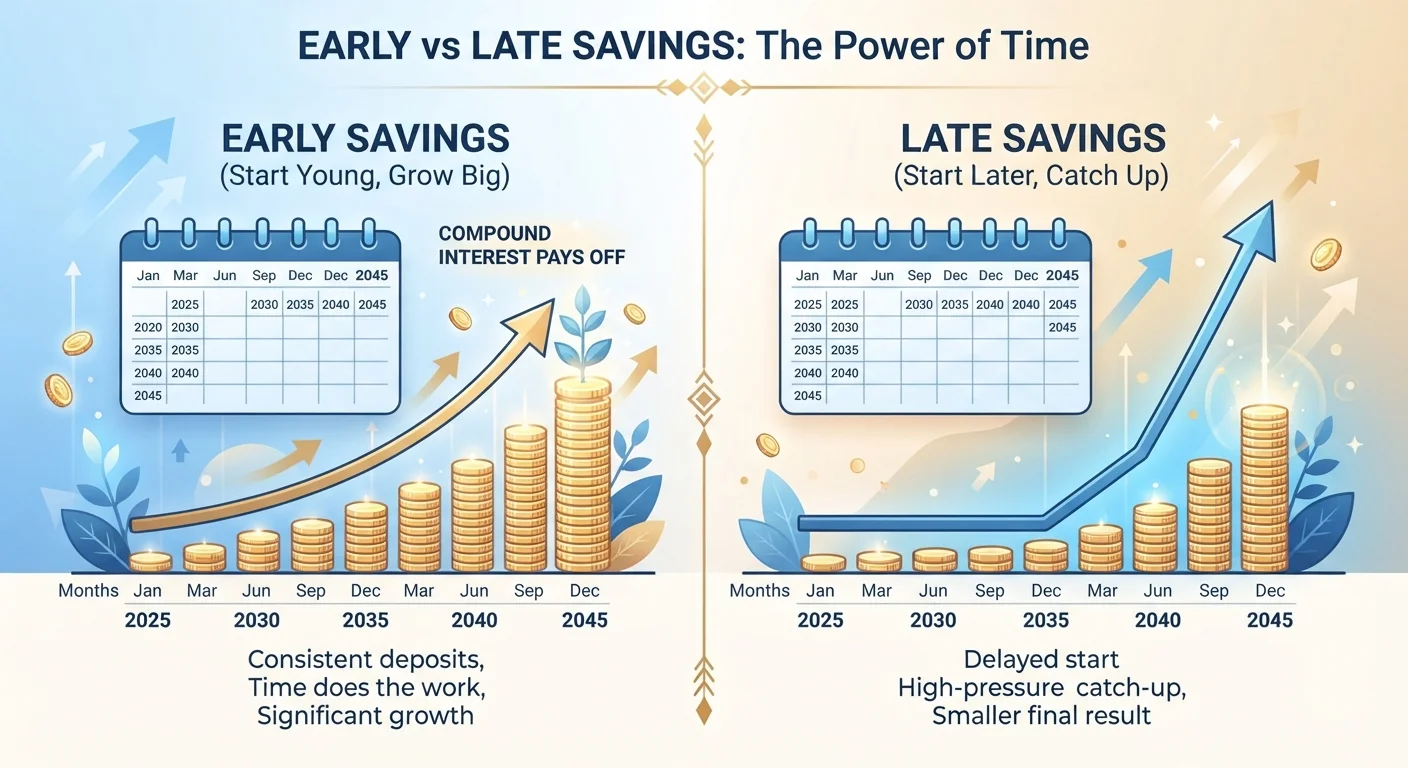
The Math Behind Delayed Saving
When it comes to retirement, time is the variable that matters most-often more than the size of any single contribution. The reason is compound growth: your returns generate their own returns, and that cycle accelerates the longer it runs. Understanding how compound interest works is the foundation for appreciating why a decade's delay is so costly.
Consider two hypothetical savers contributing $200 a month at a consistent 6% average annual return. One starts at 25 and contributes for 40 years; the other starts at 35 and contributes for 30 years. The later starter contributes only $24,000 less in total principal-but the ending balance gap is substantially larger because the early starter's first decade of gains had 30 additional years to compound. These are illustrative figures, not guarantees, but they reflect the general direction the math reliably points.
~$198,000
Potential 30-year cost of a 10-year delay
Illustrative example: $200/month invested for 30 years at a 6% average annual return vs. 20 years at the same rate shows a rough difference of this magnitude-compounding amplifies the gap over time.
26%
Americans with no retirement savings
A Federal Reserve 'Report on the Economic Well-Being of U.S. Households' found roughly one in four non-retired adults had no retirement savings or pension at all.
10x
Approximate wealth multiplier over 30 years
At a hypothetical 6% annual return, a dollar invested today roughly doubles every 12 years, potentially growing tenfold over three decades-illustrating compound growth's long-run power.
The core insight is that delays aren't neutral-they're costly in a way that's nearly impossible to make up through larger contributions alone later in life.
Common Mistakes That Push Saving to 'Someday'
Most retirement saving delays aren't the result of carelessness. They stem from predictable, understandable patterns-financial pressure, unfamiliarity with employer benefits, or simply an intuition that there's more time than there is. Recognizing these patterns is the first step to breaking them.
Waiting until income 'feels comfortable enough' to start contributing.
Why it happens: Many people assume they need a high income before retirement saving is worthwhile, treating it as a reward for financial stability rather than a tool to build it.
Prioritizing every short-term expense over retirement contributions.
Why it happens: Immediate financial pressures-rent, student loans, childcare-feel concrete and urgent, while retirement is abstract and distant. The brain naturally discounts far-future rewards.
Not contributing enough to capture the full employer 401(k) match.
Why it happens: Workers may not fully understand their plan's matching formula, or they contribute a flat amount without checking whether it meets the match threshold.
Cashing out a 401(k) when changing jobs instead of rolling it over.
Why it happens: A job transition creates financial pressure and a tempting lump sum. Many workers are unaware of the tax consequences or simply don't prioritize account management during a busy career move.
Assuming Social Security will cover most retirement expenses.
Why it happens: Social Security is a familiar, government-backed program, which can create an impression that it provides a comfortable retirement income on its own.
Each of these errors shares a common thread: they make the present feel more important than a future that's hard to visualize. Building systems-automatic contributions, calendar reminders to review accounts, a clear personal savings plan-counteracts that psychological pull.
What You Can Do Starting Now
Regardless of where you are in your career, taking action today is more valuable than waiting for a better moment. If you have access to a workplace retirement plan, enroll and at minimum contribute enough to capture any employer match. If no workplace plan is available, a traditional or Roth IRA allows most working Americans to contribute up to the IRS annual limit-check IRS.gov for current figures.
This Is General Information, Not Personal Advice
The examples and figures in this article are illustrative and based on generalized assumptions about investment growth. They are not guarantees of any specific outcome. Retirement planning depends on individual circumstances, risk tolerance, and tax situations. Please consult a licensed financial adviser before making decisions about your retirement savings.
It also helps to see retirement saving within a broader financial picture. High-interest debt can undermine saving efforts, which is why understanding the real cost of carrying debt matters alongside your savings strategy. And if you're uncertain whether to save first or pay down debt, a financial adviser can help you weigh the trade-offs for your specific situation.
Leaving Employer Match Behind Is Costly
If your employer offers a 401(k) match and you're not contributing enough to capture it, you're forgoing compensation that is part of your total pay package. According to Vanguard's annual 'How America Saves' report, a significant share of eligible workers contribute below the match threshold. Review your plan documents to understand your employer's matching formula and contribute at least enough to capture the full match.
The difference between saving and investing also shapes where retirement funds belong-generally in tax-advantaged, growth-oriented accounts rather than low-yield savings accounts. The key is to begin, contribute consistently, and resist the instinct to pause when life gets expensive.
This article is for general informational and educational purposes only and does not constitute personalized financial, investment, or tax advice. Past performance of any investment strategy does not guarantee future results. Consult a qualified, licensed financial professional for guidance tailored to your individual circumstances.