The Three Salts You'll Encounter Most
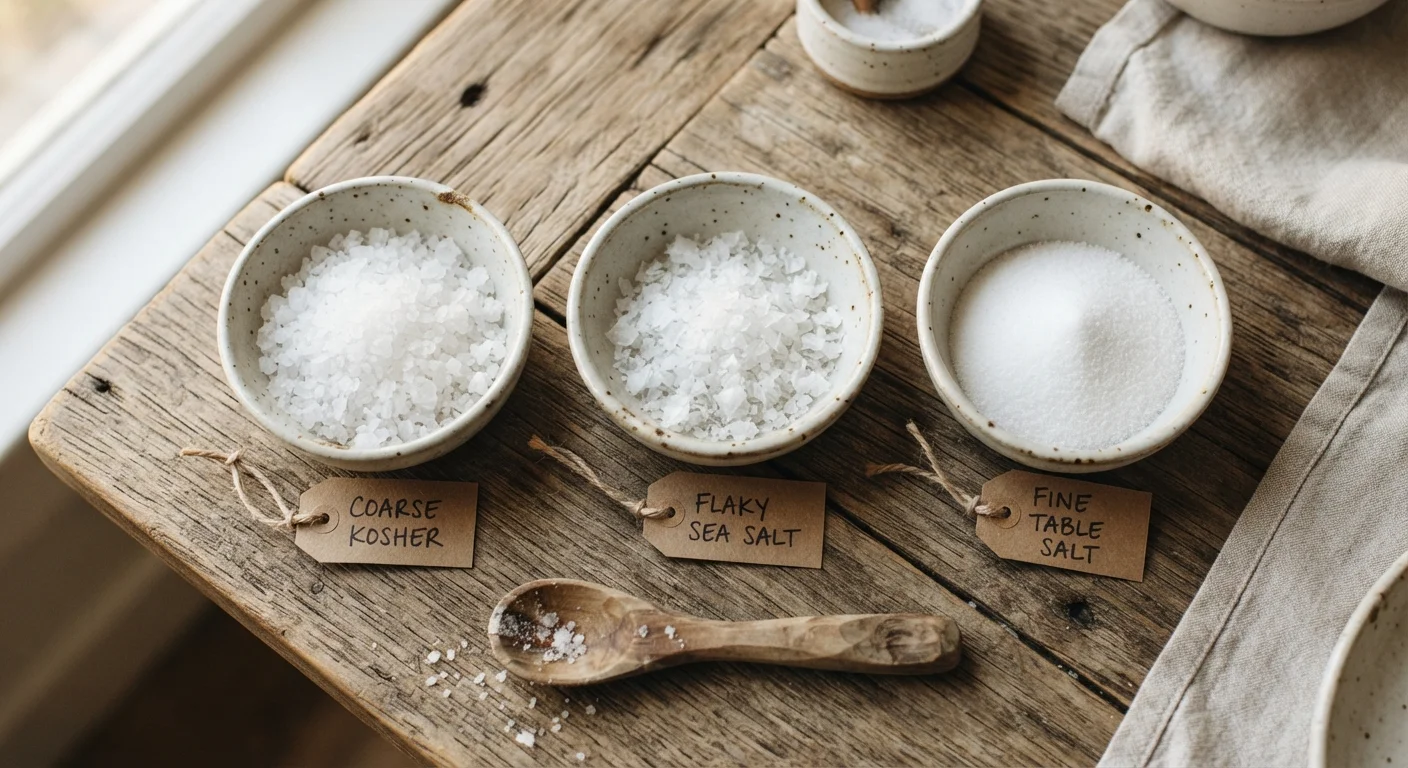
Walk into any grocery store and you'll find at least three common salt types: table salt, kosher salt, and sea salt. They all contain sodium chloride, but they behave very differently in the kitchen.
Table salt has very fine, uniform grains and often contains added iodine and anti-caking agents. It dissolves almost instantly and packs tightly into a measuring spoon, making it easy to over-season if you're used to a coarser product.
Kosher salt has larger, irregular flakes that are easy to pinch and sprinkle by hand. It's the workhorse salt in most professional kitchens precisely because its coarser texture gives cooks more tactile control. Two popular brands have noticeably different grain sizes from each other, which is why many recipe writers specify which one they used.
Sea salt is harvested by evaporating seawater and ranges from fine-grained to large, irregular flakes. Flaky sea salt varieties - often called finishing salts - are prized for their delicate crunch and visual appeal as a final garnish, not as an all-purpose cooking salt.
A Note on Iodized vs. Non-Iodized Salt
Most table salt sold in the US is iodized, meaning a small amount of iodine has been added. Kosher salt and most sea salts are typically not iodized. For everyday cooking purposes, this distinction has no meaningful effect on flavor or technique. It only becomes relevant in a nutritional context, which is worth discussing with a healthcare provider if iodine intake is a concern for you.
Why Volume Measurements Can Mislead You
Here's where many home cooks run into trouble: recipes measure salt by volume (teaspoons, tablespoons), but the actual amount of sodium those measurements deliver depends entirely on grain size.
A teaspoon of fine table salt contains roughly 2,300 mg of sodium. A teaspoon of coarse kosher salt may contain as little as 1,100-1,400 mg - less than half - simply because the larger grains leave more air space in the spoon. This is not a trivial difference. It's enough to make a dish taste aggressively over-salted or noticeably flat depending on which salt you grabbed.
~2,300 mg
Sodium in one teaspoon of table salt
This figure aligns with the FDA's daily sodium reference value for adults, meaning a single teaspoon of table salt meets an entire day's general guideline.
~50%
Less sodium per teaspoon in coarse kosher vs. table salt
Because larger grains leave air gaps in a measuring spoon, coarse kosher salt can deliver roughly half the sodium of the same volume of fine table salt.
The safest approach when a recipe doesn't specify salt type: season by taste rather than strictly by measurement. Add less than the recipe calls for, taste, and adjust. For baking - where precise chemistry matters - weigh salt in grams if possible, since weight is not affected by grain size.
Timing Changes Everything
When you add salt matters almost as much as how much you add. Salt added early in cooking - to onions softening in a pan, to a braise, or to a pot of water - has time to penetrate ingredients and integrate throughout the dish. This produces a more harmonious, rounded flavor. Early salting also draws moisture out of vegetables, which can help them soften or brown more effectively.
Salt added at the very end sits on the surface of food. This gives a bright, immediate burst of seasoning that's perceptible to your taste buds right away - which is why finishing salts work well applied just before serving a piece of grilled fish or a roasted vegetable.
Understanding aromatics deepens this concept further. Just as salt coaxes flavor from ingredients, so does building your dish on a proper flavor foundation. See our guide to cooking with aromatics to understand how salt and aromatics work together from the very start of a recipe.
Season in Layers, Not All at Once
Rather than adding all your salt at the start or all at the end, season incrementally at each stage of cooking - when softening aromatics, after adding liquid, and again just before serving. Tasting at each stage lets you build balanced flavor without risking an over-salted dish that can't be fixed.
Salt and Your Diet: Keeping Perspective
It's worth noting that the salt you add while cooking at home is rarely the main source of sodium in the American diet. Processed foods, restaurant meals, and packaged snacks contribute the overwhelming majority of dietary sodium for most people. That doesn't mean cooking salt is irrelevant to health - it simply means that mindful cooking doesn't require eliminating salt; it means using it skillfully.
For a broader look at where dietary sodium actually comes from, our sodium in the American diet overview explains which food categories drive intake and what established guidance generally recommends.
This article is for general informational and educational purposes only and is not medical or dietary advice. If you have specific health concerns related to sodium intake, please consult a qualified healthcare professional.