Why the Right Tools Actually Matter
Walk into any kitchen store and you'll find hundreds of gadgets promising to transform your cooking. Most won't. What actually makes a difference is a focused collection of tools that support core techniques - cutting, measuring, controlling heat, and mixing. When a tool reduces friction during these fundamentals, your cooking genuinely improves.
This isn't about spending a lot of money or filling every drawer. It's about understanding what each item does and why it earns a spot in your kitchen. If you're building out your space for the first time, our guide to setting up a home kitchen from scratch covers the full picture. And before any tool does its job well, good prep habits matter - mise en place is the organizing principle that makes every tool more useful.
A Quality Chef's Knife
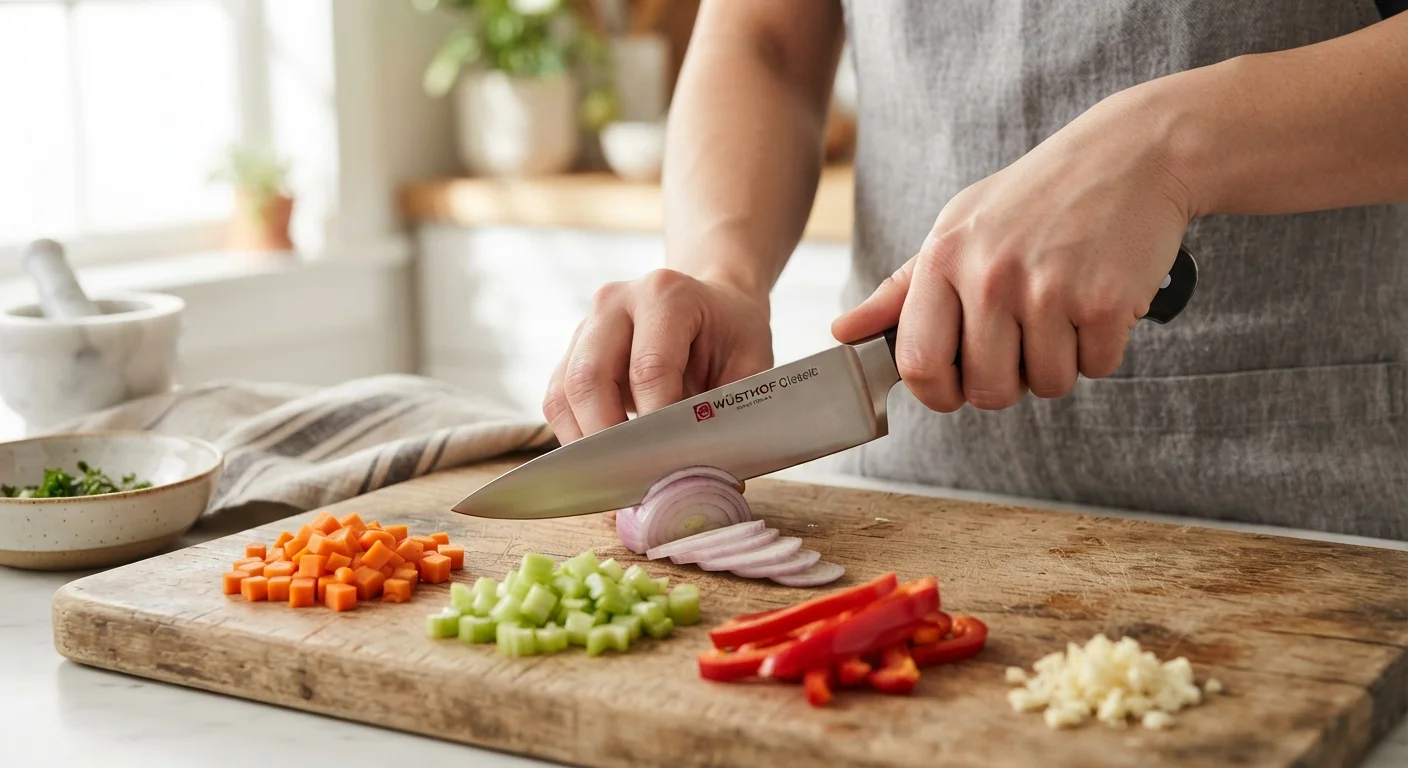
A well-balanced 8-inch chef's knife is the single most impactful tool in a home kitchen. It handles roughly 80% of all cutting tasks - chopping vegetables, slicing meat, mincing herbs. The reason it improves cooking is straightforward: a sharp, properly weighted knife gives you control. Dull or flimsy knives require more force, which makes cuts uneven and increases the risk of slipping. Uneven cuts cook unevenly, which directly affects texture and doneness.
You don't need a full knife block. One great chef's knife, kept sharp with a honing steel, outperforms a set of mediocre blades.
One sharp chef's knife outperforms an entire block of mediocre blades.
A Sturdy Cutting Board
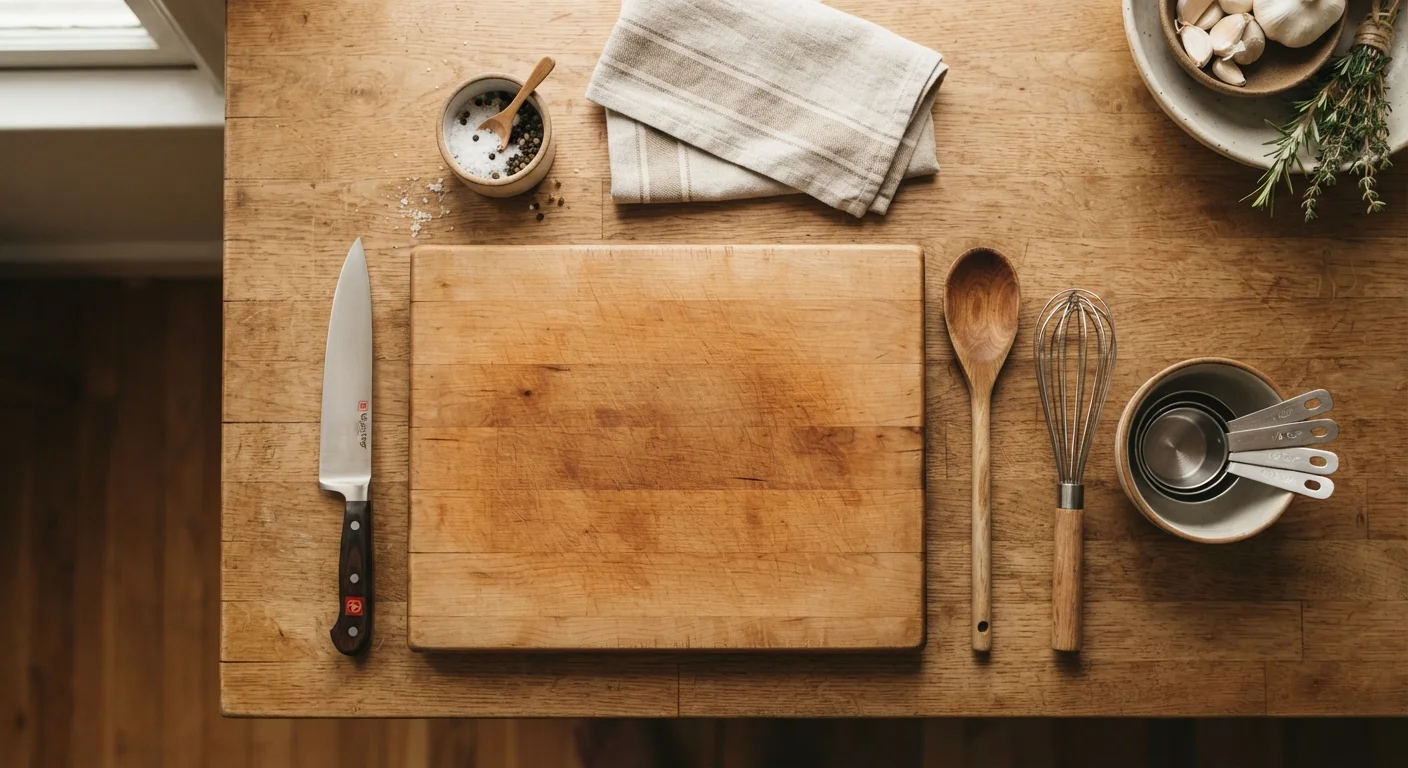
A cutting board protects your counters and, more importantly, your knife's edge. Hard surfaces like glass or ceramic dull blades quickly. A large wooden or high-density polyethylene board gives you enough room to work without crowding ingredients to the edge - a common source of accidents and inefficiency.
Size matters more than most cooks expect. A board that feels too big on the counter is almost always the right size once you're actually prepping a meal.
A spacious cutting board prevents crowding - one of the most common sources of kitchen accidents.
A Digital Instant-Read Thermometer
Visual cues - clear juices, browning, firmness - are unreliable indicators of doneness on their own. An instant-read thermometer removes guesswork from meat, poultry, fish, and even bread. It's the difference between a chicken breast that's safely cooked through and one that's dry because you left it on too long to be sure.
This is especially important for food safety: the USDA publishes minimum internal temperature guidelines for common proteins, and a thermometer is the only way to verify them accurately.
A thermometer is the only reliable way to verify food safety and avoid overcooking at the same time.
A Heavy-Bottomed Skillet
Pan weight and material directly affect how food cooks. A thin, lightweight pan creates hot spots and temperature swings - food scorches in one area while staying pale in another. A heavy-bottomed skillet (cast iron or stainless steel are common options) distributes heat more evenly and retains it when food is added, which is essential for achieving a proper sear.
Searing, sautéing, pan sauces - a quality skillet handles all of it. Understanding when to use the stovetop versus the oven is a related skill worth developing; see our stovetop vs. oven guide for context.
Even heat distribution is why pan weight matters - thin pans create the hot spots that burn food unevenly.
Dry and Liquid Measuring Tools
Baking is chemistry, and even savory cooking benefits from accurate proportions. Dry measuring cups (used for flour, sugar, and similar ingredients) and liquid measuring cups (with a pour spout, read at eye level) are not interchangeable - using a liquid cup to measure flour, for example, consistently yields inaccurate amounts.
A set of measuring spoons rounds this out. Once you understand the logic of these tools, you'll also start to recognize when recipes are structured around weight rather than volume - a distinction worth understanding as your skills develop.
Dry and liquid measuring tools are not interchangeable - using the wrong one throws off proportions every time.
A Whisk
A whisk does specific mechanical work that no spoon or fork replicates well: it incorporates air and breaks up clumps efficiently. Emulsifying a vinaigrette, smoothing a pan sauce, combining dry ingredients evenly - all of these benefit from the rapid, multi-wire action a whisk provides. If you've ever ended up with lumpy gravy or a broken dressing, a whisk (used correctly) typically solves both problems. For a deeper look at mixing techniques, what fold, whisk, and stir actually mean clarifies when each approach applies.
A whisk incorporates air and breaks clumps in ways no spoon or fork can replicate.
Put These Tools to Work
Owning these tools is only step one. Using them with intention - knowing why each one exists and what it enables - closes the gap between a frustrating cook and a confident one. Once you're comfortable with your knife, spend time on knife skills every home cook should know to build real speed and safety. And if recipes still feel confusing, reading a recipe before you start will help you catch problems before the heat is on.
Fewer Tools, Used Well
Resist the pull of single-use gadgets - most tasks they handle can be done with the core tools you already own. Before adding anything new to your kitchen, ask what technique it supports and how often you actually use that technique. A drawer with six reliable tools beats a cabinet full of items you reach around to find what you need.
The goal is a kitchen that works for you - organized, capable, and free of tools you never reach for. If your drawers are becoming a graveyard of single-use gadgets, reorganizing your kitchen drawers is a practical place to start reclaiming that space.