
Why These Three Numbers Are Routinely Confused
Homeowners regularly encounter three distinct valuations attached to their property: home equity, market appreciation, and assessed value. They appear in mortgage statements, tax bills, and real estate listings - often without explanation. Each number serves a different purpose, answers a different question, and is calculated by a different party. Conflating them leads to real financial miscalculations, from overestimating borrowing power to misunderstanding a property tax bill.
| What equity measures | Market value minus mortgage balance |
| What appreciation measures | Change in market value over time |
| What assessed value measures | Government valuation for property tax calculation |
| Who calculates assessed value | Local government tax assessor |
| Who calculates market value (for lending) | Licensed independent appraiser hired by lender |
| Typical LTV limit for home equity borrowing | 80-85% of appraised value (General industry standard; individual lenders vary) |
This article defines each concept clearly, explains how it is determined, and shows where the numbers diverge - sometimes dramatically.
Home Equity: What You Actually Own
Home equity is the portion of your home's value that you own outright - free of mortgage debt. It is calculated as:
Equity = Current Market Value − Outstanding Loan Balance(s)
If your home is currently worth $380,000 and you owe $210,000 on your mortgage, your equity is $170,000. Equity grows in two ways: as you pay down principal on your loan, and as your home's market value rises. It can also shrink if home values fall or if you take on additional debt secured by the property, such as a home equity line of credit (HELOC).
Equity matters most when you want to borrow against your home, sell it, or calculate your net worth. Lenders use a metric called the loan-to-value ratio (LTV) - your loan balance divided by appraised value - to determine how much equity-based credit you qualify for. Most lenders require you to retain at least 15-20% equity after any borrowing. For context on how equity fits into the broader rent-vs-own decision, see our comparison of renting vs. buying.
Market Appreciation: How Your Home's Value Changes Over Time
Market appreciation refers to the increase in a property's market value over time. It is not a fixed number on a document - it is a percentage change calculated by comparing a home's current estimated market value to its value at an earlier point.
Home Equity
The difference between a property's current market value and the total amount owed on any loans secured by it. Equity represents the owner's financial stake in the property.
Market Appreciation
The increase in a property's market value over a defined period. Appreciation is driven by supply-and-demand dynamics, local economic conditions, and property improvements.
Assessed Value
A value assigned by a local tax assessor used solely to calculate property taxes. It is often a fixed percentage of estimated market value and typically updates on an annual or periodic basis.
Loan-to-Value Ratio (LTV)
A lending metric calculated by dividing the outstanding mortgage balance by the property's appraised value. Lenders use LTV to assess risk and determine borrowing eligibility.
Assessment Ratio
The percentage of a property's estimated market value used by a jurisdiction to set its assessed value. For example, a 70% ratio means a $400,000 home is assessed at $280,000.
Mill Rate
The tax rate applied to assessed value to calculate a property tax bill. One mill equals $1 of tax per $1,000 of assessed value.
Appreciation is driven by factors largely outside a homeowner's control: local employment trends, housing supply and demand, interest rate environments, neighborhood development, and broader economic conditions. Individual improvements - a renovated kitchen, an added bathroom - can also contribute, though not always dollar-for-dollar.
It is important to understand that appreciation is unrealized until you sell. A home that has appreciated $90,000 over five years has not put $90,000 in your pocket; it has increased your equity on paper. That gain becomes real only at closing, minus selling costs. Appreciation also is not guaranteed - markets can and do decline. Homeownership costs beyond the mortgage, covered in our article on hidden costs of homeownership, can also offset appreciation gains.
Assessed Value: The Government's Number for Tax Purposes
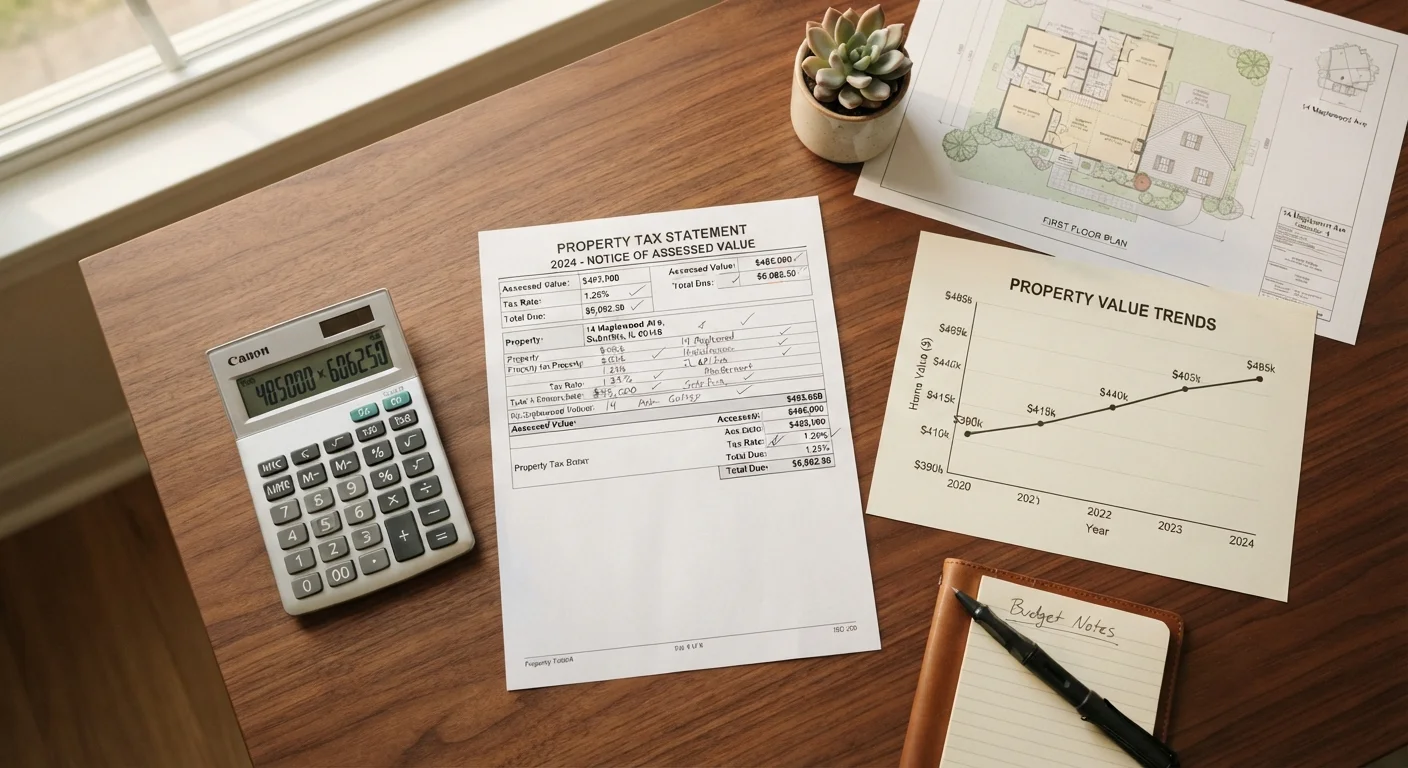
Assessed value is assigned by your local government's tax assessor and is used exclusively to calculate your property tax bill. It is not the same as market value, and it is almost never used by buyers, sellers, or mortgage lenders.
Assessors typically value properties using mass appraisal methods - analyzing sales data across comparable properties in a jurisdiction - rather than individual inspections. Many jurisdictions assess at a fixed percentage of estimated market value, called an assessment ratio. For example, a county with a 70% assessment ratio would assign an assessed value of $266,000 to a home with an estimated market value of $380,000.
Your annual tax bill is then calculated by multiplying the assessed value by the local mill rate (tax rate). Most homeowners can appeal their assessed value if they believe it is inaccurate. For a detailed breakdown of how tax bills are calculated and what exemptions may reduce your burden, see our guide to property taxes.
You Can Challenge an Inaccurate Assessment
If your assessed value seems too high relative to actual market conditions, most jurisdictions allow homeowners to file a formal appeal. The appeal process typically requires comparable sales data or an independent appraisal to support your case. Deadlines are strict and vary by locality - check with your local assessor's office for specific procedures and timelines.
How the Three Numbers Interact - and Where They Diverge
In a stable market, assessed value, market value, and equity all tend to move in the same general direction. In practice, however, they frequently diverge:
- Assessed value lags market value. Assessments often update annually or less frequently. In fast-rising markets, your assessed value may be significantly below current market value - a gap that can work in your favor on taxes but can mislead you about actual equity.
- Market appreciation does not directly increase equity dollar-for-dollar. If you owe a large balance, appreciation increases equity only to the extent it raises market value above that debt.
- A lender's appraisal may differ from the assessed value. When you refinance or apply for a HELOC, lenders order an independent appraisal. That figure, not the tax assessment, determines your borrowing capacity.
Understanding how encumbrances or liens on your property interact with equity is equally important - learn how liens and title issues affect your property rights.
~$300,000
Median homeowner equity in the US
According to CoreLogic data published in 2024, the median US homeowner with a mortgage held approximately $300,000 in home equity.
Varies widely
Assessment ratio by jurisdiction
Assessment ratios range from 100% of market value in some states to as low as 10% in others, reflecting wide variation in how localities fund public services.
This article is for general informational purposes only and does not constitute financial, tax, or legal advice. Consult a qualified financial adviser, tax professional, or attorney for guidance specific to your situation.