
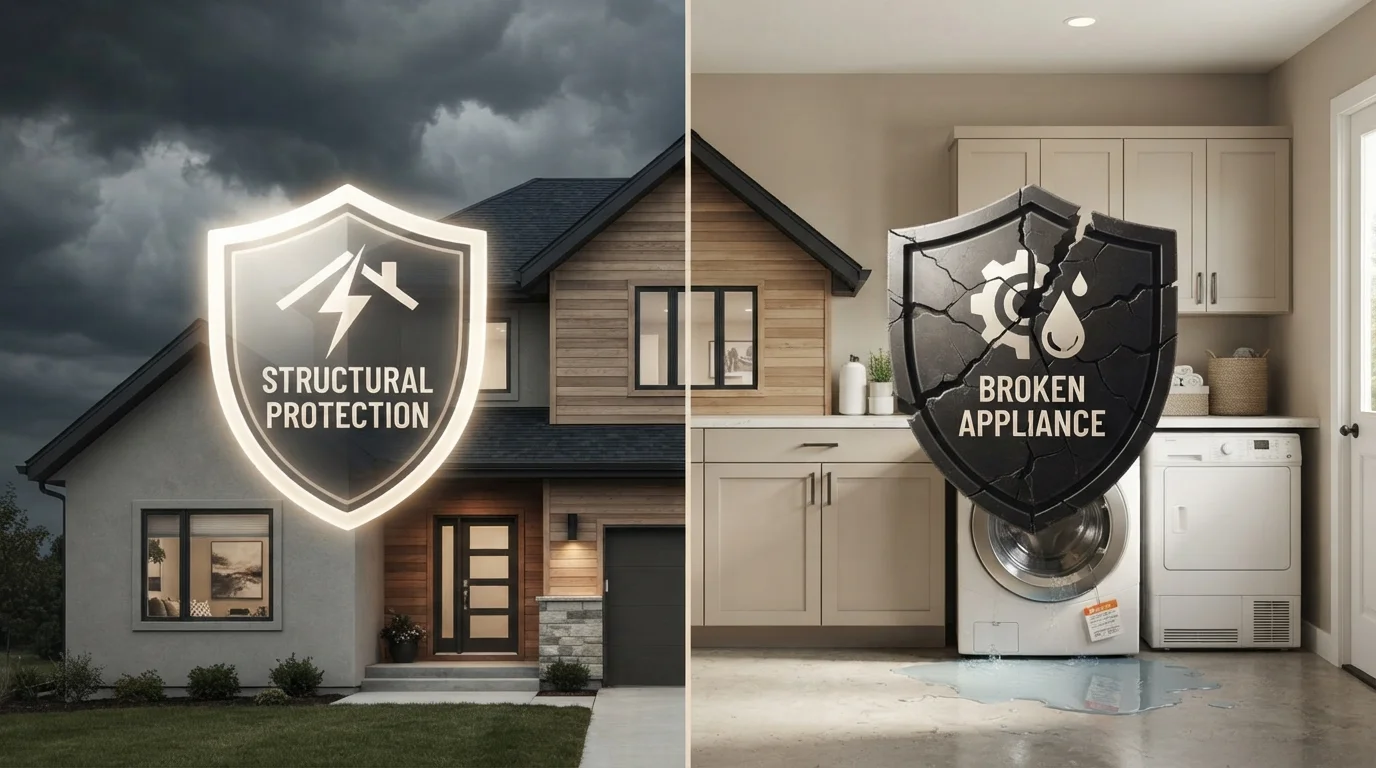
What Each Product Actually Does
Confusion between these two protections is common - and costly. Homeowners sometimes discover at the worst possible moment that the coverage they assumed they had doesn't apply to their situation. The clearest way to separate them is to focus on what causes the loss.
Homeowner's insurance responds to sudden, unexpected events: a fire destroys your kitchen, a tree falls through your roof, a guest slips on your driveway and sues you, or a burglary empties your home office. It is a true insurance product regulated by state insurance departments, and it pays out when an unforeseen peril strikes your home or your finances.
A home warranty responds to something entirely different: the gradual, predictable breakdown of systems and appliances through normal use. When your furnace stops working in January, your dishwasher motor burns out, or your water heater rusts through after 12 years of service, a home warranty steps in to cover repair or replacement costs - subject to the contract's specific terms and any service fee you owe.
These two products are designed to sit alongside each other, not substitute for one another. For a deeper look at what a standard insurance policy actually covers, see our guide to homeowner's insurance coverage and its common gaps.
| Criterion | Homeowner's Insurance | Home Warranty |
|---|---|---|
| Type of product | Regulated insurance policy | Service contract |
| What triggers coverage | Sudden, accidental perils (fire, storm, theft) | Normal wear and tear / mechanical failure |
| Typical annual cost | Varies widely; often $1,000-$3,000+ | Typically $300-$1,200+ |
| Out-of-pocket at claim time | Deductible (commonly $1,000-$2,500) | Service call fee (often $75-$125) |
| Required by mortgage lender | Yes, typically required | No, entirely optional |
| Covers structural damage | Yes | No |
| Covers appliance breakdown | No | Yes (per contract terms) |
| Covers liability (injury/lawsuit) | Yes | No |
| Pre-existing conditions | May apply to older structures | Typically excluded |
| Regulated by | State insurance departments | State consumer protection laws (varies) |
Coverage Details, Costs, and Key Exclusions
Understanding the cost structure of each product helps set realistic expectations before you file a claim.
Homeowner's insurance is priced as an annual premium based on your home's rebuild value, location, claims history, and chosen deductible. The national average annual premium has grown in recent years due to climate-related loss trends, though costs vary significantly by state and insurer. When you file a claim, you pay the deductible - often $1,000 to $2,500 - and the insurer covers the remainder up to your policy limits. Flood and earthquake damage are standard exclusions that require separate policies.
Home warranties are typically priced as an annual contract fee, commonly ranging from a few hundred to over a thousand dollars depending on coverage tier, plus a per-service-call fee (often $75-$125) each time a technician visits. Crucially, warranties exclude pre-existing conditions and items that were improperly installed or inadequately maintained - which is why a thorough home inspection before purchase can matter enormously for warranty claims later.
Read the Home Warranty Contract Carefully
Home warranty contracts vary considerably between providers in terms of what systems and appliances are covered, coverage caps per item, and what constitutes an excludable pre-existing condition. Before purchasing a warranty, review the exclusions section in detail and ask specifically how the company determines whether a breakdown qualifies. Understanding the fine print upfront prevents disputes at claim time.
A renovation can also affect both products. Significant additions or upgrades can change your home's insured rebuild value and may introduce warranty complications if unlicensed work is involved. Our article on how renovations affect homeowner's insurance coverage covers what homeowners need to address proactively.
Making the Right Choice for Your Situation
For most homeowners carrying a mortgage, homeowner's insurance is non-negotiable - lenders require it, and the financial exposure from a major loss without it is severe. The question is really whether a home warranty makes sense on top of that baseline.
A home warranty tends to offer the most value when: your home's mechanical systems are aging (typically 7 or more years old); you have limited cash reserves for unexpected repair bills; or you are buying a home whose system history is unclear. Newer homes with builder warranties and newer appliances may see less immediate value from an add-on service contract.
~98%
US mortgaged homes with required insurance
Virtually all mortgage lenders in the United States require active homeowner's insurance as a loan condition, making it the baseline protection for the vast majority of homeowners.
$6,000+
Average HVAC replacement cost
Industry estimates suggest central HVAC system replacement commonly runs several thousand dollars - a cost a home warranty may partially offset, subject to contract limits.
Renters face a parallel decision with different variables - if you are comparing protections for a rental situation, our overview of renters insurance coverage explains what that product does and does not address. And if you live in a community with an HOA, it is worth understanding how the association's master policy may interact with your own coverage - our guide to HOA rules and homeowner rights covers the key concepts.
This article provides general information about home warranty and homeowner's insurance products for educational purposes only. It is not legal, financial, or insurance advice. Consult a licensed insurance professional or financial adviser before making coverage decisions for your specific situation.