
Why Garages Become Dumping Grounds
The garage has a structural problem: it's the one room in the house with no clear social function. Bedrooms sleep, kitchens cook, living rooms gather - but the garage just sits there, door open, ready to absorb whatever doesn't have a home elsewhere. Over months and years, it quietly fills with sports equipment, half-empty paint cans, holiday decorations, tools borrowed from neighbors, and items you're "not ready to deal with yet."
The result isn't laziness - it's a system failure. When there's no defined place for something, the garage becomes the default answer. Fixing that means creating clear homes for categories of items, not just tidying what's already there.
If the garage problem feels familiar on a larger scale, the decluttering from scratch guide offers a solid starting framework for tackling accumulated clutter anywhere in the home.
25%
Homeowners who can't fit a car in their garage
According to a U.S. Department of Energy survey, roughly one in four homes with a garage cannot park a vehicle inside due to stored items.
3x
More storage capacity from vertical wall use
Organization experts commonly estimate that fully utilizing wall height can triple usable storage capacity in a standard two-car garage.
The Full Purge: Sorting Before Storing
Before touching a shelf or buying a single bin, pull everything out of the garage. Yes, everything. This step feels dramatic, but it's the only way to see what you actually have - and it prevents the common mistake of organizing around items that should have left years ago.
Sort into four groups as you go:
- Keep: Used at least once in the past year and serves a clear purpose.
- Donate or sell: Still functional but no longer needed by your household.
- Trash or recycle: Broken, expired, or genuinely unusable.
- Relocate: Belongs somewhere else in the house, not the garage.
Be honest about the "keep" pile. Duplicates, broken tools awaiting repair that never comes, and items kept out of vague guilt are the primary sources of garage clutter. The room-by-room audit guide offers useful prompts for making these decisions without overthinking each item.
Don't Buy Storage Before You Sort
It's tempting to head to the hardware store first, but buying bins and shelving before you know what you're keeping is one of the most common (and costly) garage mistakes. You'll almost certainly buy the wrong sizes, wrong quantities, or storage types that don't suit what you actually have. Finish the full purge and grouping step first, then shop with a list.
Zoning Your Garage for Real Life
Once you know what's staying, group similar items together and think in zones. A zone is simply a dedicated area for a category of activity or gear. Common zones for most households include:
- Automotive: Car care supplies, tire inflator, jumper cables, seasonal accessories.
- Yard and garden: Long-handled tools, fertilizer, hoses, sprinklers, seeds. (Gardeners managing seasonal tools may also find the seasonal rotation guide useful.)
- Workshop/tools: Hand tools, power tools, hardware, workbench space.
- Sports and recreation: Bikes, balls, camping gear, pads, rackets.
- Seasonal storage: Holiday decorations, off-season clothing, bulky items used only part of the year.
Assign zones based on frequency of use. Items grabbed daily - dog leashes, bike helmets, sports bags - belong closest to the door. Seasonal items that come out twice a year can live in harder-to-reach overhead space.
Map your zones on paper before moving a single item. A rough sketch of the garage footprint with labeled areas forces you to think about traffic flow and access frequency before committing to a layout.
Rearranging heavy shelving multiple times is one of the most common wasted efforts in garage projects - a five-minute sketch prevents hours of rework.
Mount a small whiteboard near the garage entry door and write down anything you run out of or need to replace. This turns the garage into a self-replenishing system instead of a mystery.
Garages store consumables - batteries, light bulbs, motor oil - that often run out unnoticed. A visible reminder list closes that loop without requiring a mental inventory.
Storage Systems That Actually Hold Up
The storage approach matters as much as the sorting. Garages are tough environments - temperature swings, moisture, and heavy use demand durable solutions. A few principles hold across most setups:
Use the walls aggressively
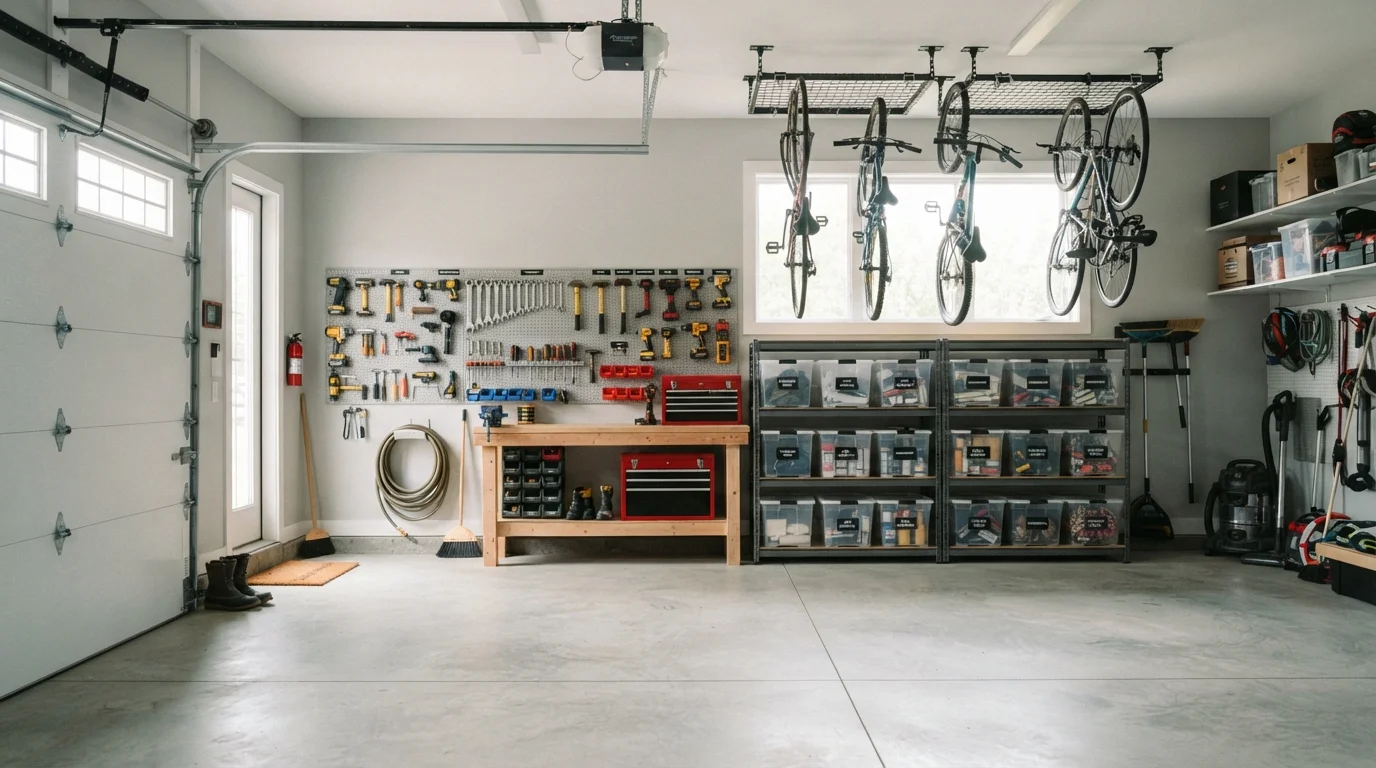
Floor space is precious; walls are often wasted. Heavy-duty shelving brackets, pegboards for hand tools, and wall-mounted bike hooks keep frequently used items accessible without consuming floor area. Vertical organization is the single biggest capacity upgrade most garages can make without structural work.
Choose clear or labeled containers
Opaque bins become black holes. If you can't see inside, you'll stop trusting the system and start creating piles again. Clear bins work well for smaller hardware and seasonal items. For opaque totes, apply a bold label on the front and side so you can identify contents from any angle. The logic behind open shelving vs. closed storage applies here just as much as indoors.
Keep the floor clear
A clear floor isn't just about aesthetics - it allows safe movement, lets you actually park a car, and prevents moisture and pest problems that develop under stored items. Use furniture risers, ceiling-mounted pulley systems for bulky gear, and wall-mounted racks to get everything off the ground.
Label Both Front and Side of Every Bin
When bins are stacked or shelved in rows, labels on only the front become invisible. Affix labels to both the front face and one side of every container so you can identify contents no matter how they're positioned or stacked. Consistent label placement makes the system usable for every member of the household, not just the person who set it up.
Maintaining the System Over Time
The most common reason garage organization fails isn't the initial setup - it's the lack of a maintenance habit. Two practices make the difference:
The "one in, one out" rule. When something new enters the garage, something old leaves. This prevents incremental accumulation from undoing the system over months.
A quarterly reset. Four times a year - roughly aligned with season changes - spend 20-30 minutes walking through each zone, returning misplaced items, discarding empties, and reassessing whether anything has outgrown its usefulness. This is also the right moment to rotate seasonal gear in and out of accessible storage.
Shared households add another layer of complexity. When multiple people use the garage, clear labeling and defined zones do the heavy lifting - they remove ambiguity about where things belong. The shared household organization guide covers how to build systems that hold up even when people have different tidiness standards.
A well-organized garage doesn't require perfection - it requires a structure clear enough that putting things back is easier than leaving them wherever they land.
This article is for general informational and educational purposes. Always follow manufacturer guidelines for storage products and consult a qualified contractor before making structural modifications to your garage.